IIThe Working Country
In this chapter
- 7vMarker IX, protocols
- 8vThe Meridian Spine
- 9rThe Filament Guild
- 9vThe Brassgate
- 10rLong saturation, weather
- 11rThe Bathymetric Conservancy
- 11vIris snail
- 12rTide-coral
540 m – 600 m · human
The Meridian Spine
The deepest permanent human city, a sealed-hull enclave between five hundred forty and six hundred metres accessible only by atmospheric diving suit.
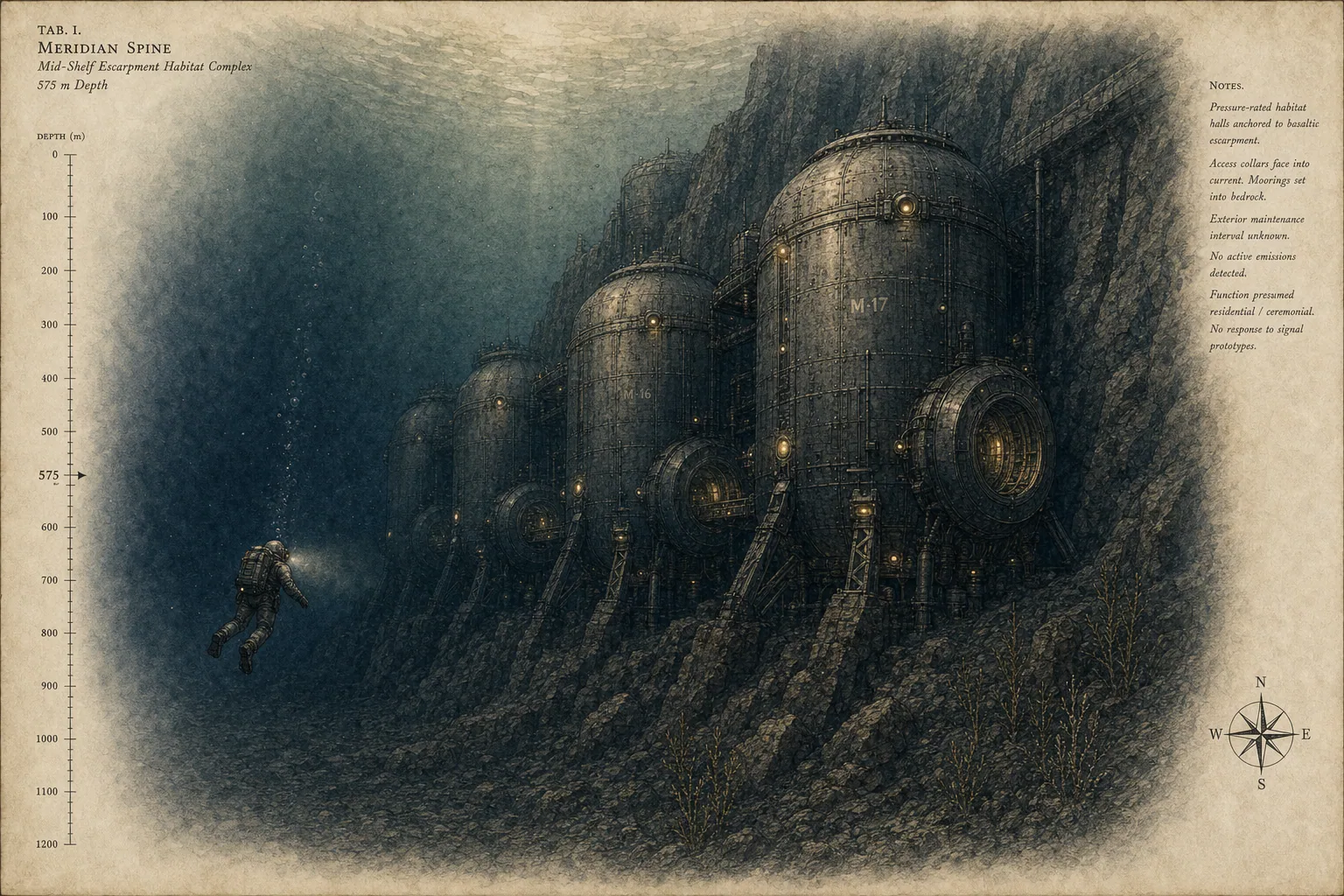
I have spent eleven days at a stretch in the Spine and written almost nothing about it that was not weather or instrument. The hab is the working country at its most legible: hull-continuous, windowless, the furthest one can go without the suit becoming the body. I include the entry here because the chapter is about depths one accumulates a relation with, and the Spine is the depth at which I stopped projecting forward in any real way.
The Meridian Spine is the lowest point at which humans have built something they call a city without apparent irony. It sits between five hundred forty and six hundred metres along the mid-shelf escarpment, a column of interconnected pressure hulls anchored to the rock face by a grid of expansion bolts and structural tethers. Approach is by ADS: there is no saturation ingress route and no diver in contact with the water at these depths. The Conservancy's engineering documentation lists it as a hull-continuous settlement, its internal environment maintained at one atmosphere throughout.
Ingress
The Spine's docking collars are sized for the standard ADS classes in current Conservancy service. Transit from the nearest upper anchorage takes between three and four hours by ADS sortie — long enough that most arrivals spend their first conscious moments in the Spine's decompression anteroom doing nothing but adjusting to the stillness. The suits remain in the outer lock; the occupant steps through in ordinary clothes. The transition is abrupt in a way that the pressurised-habitat approach is not.
What the city contains
Roughly nine hundred permanent residents at last Conservancy census, though the figure is disputed — the Spine does not participate in the surface census protocols, and its own count has not been shared. The infrastructure supports long-term saturation-equivalent habitation: closed-loop air, hydroponic food supplementation, medical facilities rated for the standard pathologies of long confinement at pressure. There are no windows. The external hull is solid at this depth; viewports are structurally inadvisable and were never installed.
Its position in the hierarchy
The Spine is not administratively exceptional. It has no special status within the Conservancy's framework and no claim to priority in the resupply queue. It is simply the furthest anyone has gone and stayed. That this is not a celebrated fact among its residents is, perhaps, the most interesting thing about it.
No viewports, by design. After three rotations I no longer experience the absence as deprivation. Whether this is acclimation or attrition is a question the body does not reliably answer.