IIThe Working Country
In this chapter
30 m – 100 m · fauna
Iris snail
A small kelp-blade gastropod with a brilliantly iridescent muscular foot, common at recreational depths near kelp-forest habitats and harmless to divers.
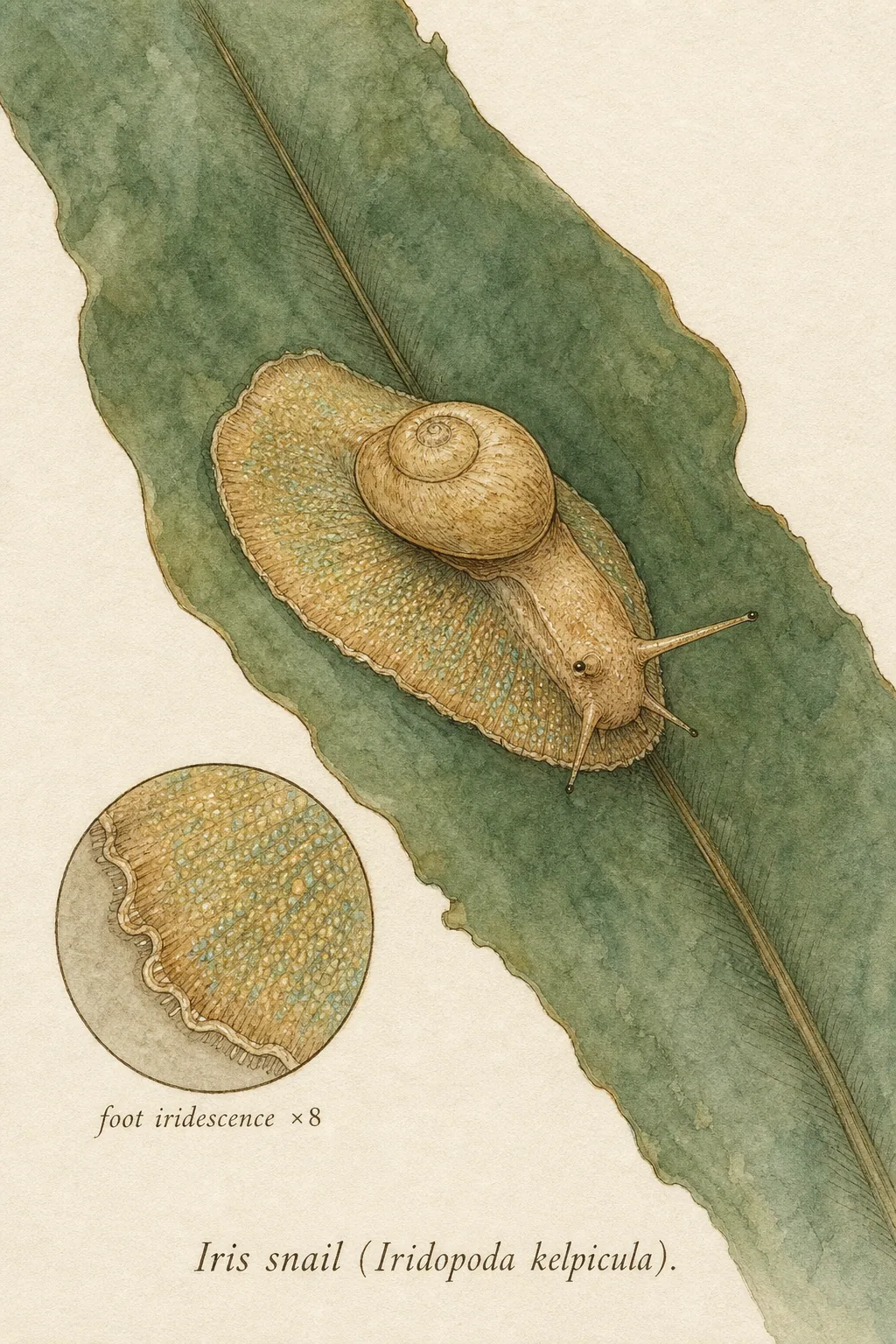
The iris snail is in this chapter because the working country includes the depths one passes through on the way down and stops attending to. I have hovered over kelp blades at Karrowin and counted a dozen on a single square metre without thinking of it as observation. The entry is a correction.
The iris snail is small — shell length between eight and twenty-two millimetres — and it is common, and it is, on almost every measure, unremarkable. It grazes kelp blades. It moves slowly. It is not eaten by anything the survey has found particularly interesting. What it has, in compensation, is its foot.
The muscular foot of Iris — the snail has not received a formal binomial in the survey record, which is its own comment on priority — produces a structural iridescence across a wide angular range. This is not pigment. The foot tissue contains ordered microstructures that refract incident light and return it in spectrum-shifted bands. In ambient shelf light, the foot is blue-green. In low-angle light, it becomes gold. A night dive with a focused beam can produce, from a single animal, the full visible spectrum in sequence as the beam angle changes.
Ecology
The species grazes the upper blade surface of shelf kelps, including phosphor-kelp, leaving narrow cleaned tracks that are visible to a diver hovering close. It does not appear to graze below the photic zone. Population density at Karrowin Halt is sufficient that the kelp blades, at certain seasons, carry a dozen animals per square metre without apparent stress to the plant.
In the field
The iris snail is routinely the first animal a new diver learns to name. It is findable, slow, and dramatic at close range. It does not retract from approach; it is not disturbed by a diver's presence. It can be studied, at any recreational depth on the outer shelf, by the simple method of hovering quietly and looking at the kelp.
Routinely the first animal a new diver learns to name. I am no longer a new diver and I still find it findable, slow, and dramatic at close range, which is a sufficient reason for a species to remain in the archive.