IIThe Working Country
In this chapter
800 m – 1,400 m · flora
Tide-coral
Litholumen vexata
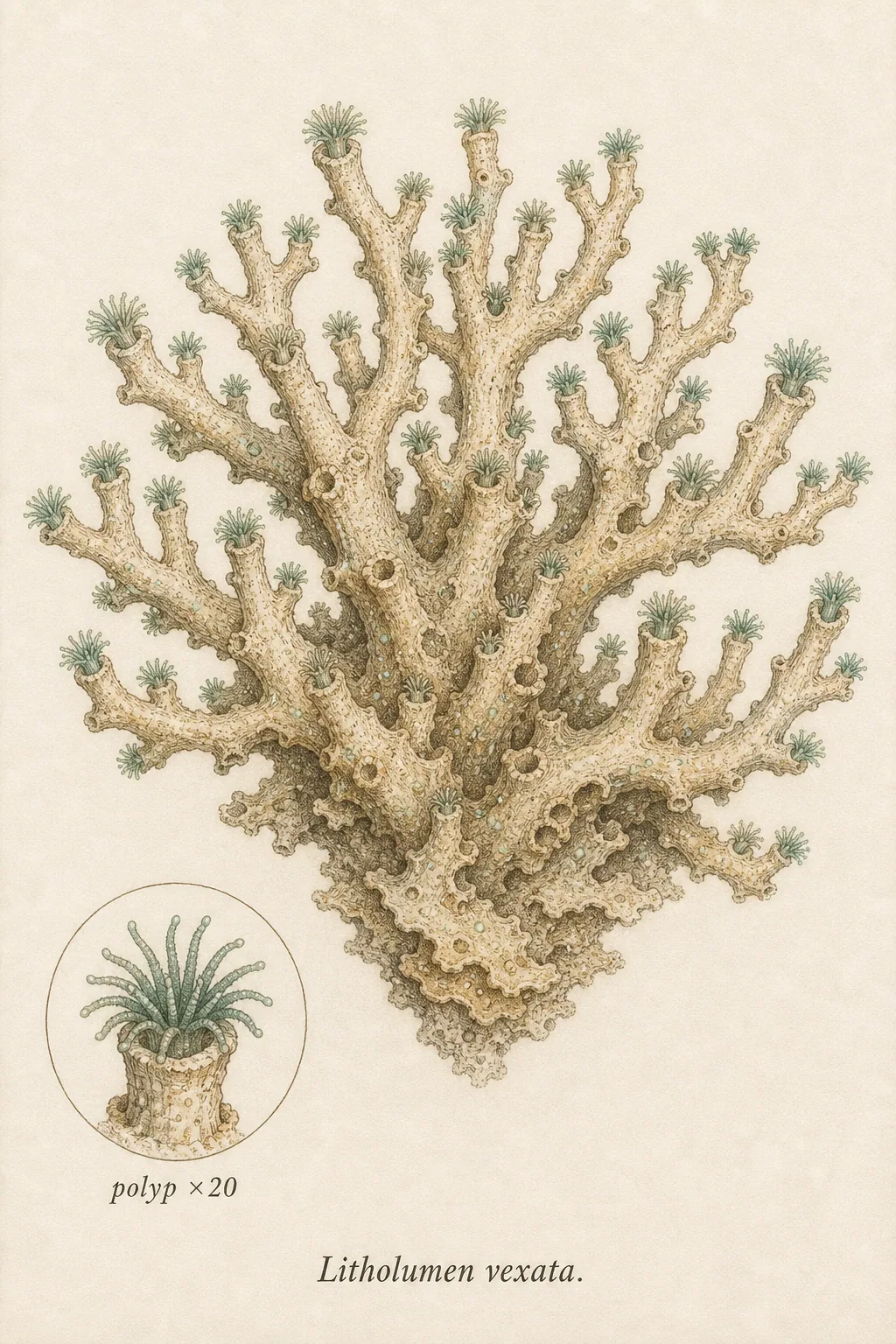
I have only ever seen Litholumen from a saturation diving system at the upper edge of its range, and the entry reflects that limitation. It belongs in the working country because the working country includes the organisms one is briefed about as a navigational hazard before one is briefed about them as life.
The name is wrong. Litholumen vexata is not a coral and does not build reef. It is a living consortium: a rigid mineralised scaffold produced by sessile flora, colonised and driven at the metabolic level by a population of chemosynthetic microbes that depend on the vent-driven tidal cycling of dissolved compounds. The flora could not produce the scaffold without the microbes; the microbes are not expressed at all outside the scaffold. What to call this arrangement — symbiosis is the nearest word, and it is insufficient — is a question the survey has not resolved to its own satisfaction.
At the Black Lung vent field, Litholumen formations reach two metres in height and cover sections of the ledge in something that looks, at a glance from a saturation diving system, like grey-white brushwork. It is inert until touched or pressure-waved.
Structure
The scaffold is acellular — mineral, not biological — and is produced over years by the flora's basal tissue. The microbe population occupies the internal channels of the scaffold, which are perfused by vent water. The outer surface is covered by a thin biological film that produces, under mechanical stress, a dim blue-green phosphorescence. This light is brief, does not repeat, and does not appear to serve any communicative function that has been identified.
Distribution
Confirmed only near active vent fields. Collections from inactive or cooling sites show the scaffold intact and the consortium dead throughout. The species appears to be strictly thermochemically dependent. At the Black Lung, the formations are sufficiently dense to constitute a navigational hazard at low depth within the ledge system; ADS operators are briefed accordingly.
The phosphorescence is brief, does not repeat, and does not appear to serve any communicative function that has been identified. I am wary of appears to in this entry; I have left it standing.