IIThe Working Country
In this chapter
- 7vMarker IX, protocols
- 8vThe Meridian Spine
- 9rThe Filament Guild
- 9vThe Brassgate
- 10rLong saturation, weather
- 11rThe Bathymetric Conservancy
- 11vIris snail
- 12rTide-coral
2186-11-22 · 560 m
Long saturation, weather
Eleven days into a saturation rotation at the Meridian Spine, a surface storm makes itself known only as a trace on an instrument, and the end of the rotation becomes a thing that is hard to want.
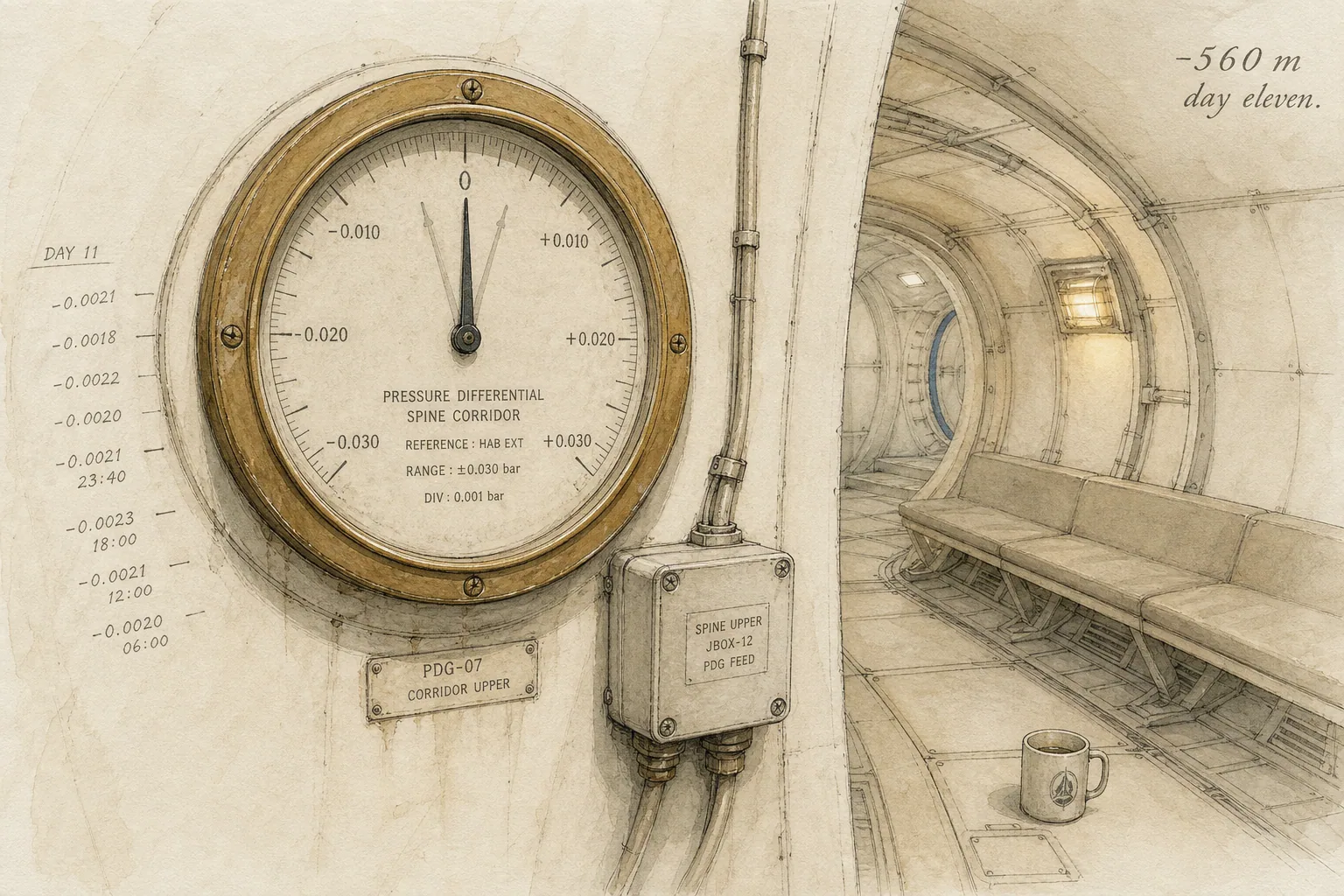
Day eleven of a saturation rotation at the Spine, and the entry I keep returning to whenever I want to explain what the rotation does to the interior life. The needle moved at the fourth decimal and I noticed; the end of the rotation was four days off and I had to remind myself to want it. Both facts belong to the same chapter.
The instrument is a pressure-differential gauge mounted near the junction box on the hab's upper corridor, an analogue dial no one has replaced because it has never failed. It does not measure weather. It measures the sum of pressures above us, which at this depth is so dominated by water that a surface storm registers as a tremor at the needle's fourth decimal, a quiver that would be invisible if you did not know to watch for it.
I watch for it. Day eight. Day nine. Day eleven.
The storm has been running for four days, according to the uplink brief that Bathymetric Conservancy central sends each morning. A significant low, tracking east-northeast, surface vessels rerouted. None of this is relevant to us. The Meridian Spine hab sits below five hundred and fifty metres of water that does not care what the air is doing, and the storm will pass without our assistance or opposition.
And yet the needle moves. Slightly. Consistently. A signature.
This is what eleven days in saturation does to the interior life: it locates interest in the very small. On day one I was completing sentences in my head and thinking about what I would do when I surfaced. By day four I had stopped projecting forward in any real way. The hab has its rhythms — the pressure checks, the sleep cycle, the maintenance rounds, the food, the log — and these become the shape of time rather than its content. You do not experience duration. You experience sequence.
The storms on the surface were a thing I used to watch from tenders and anchorages, with the particular relationship to weather that comes from being exposed to it. You had opinions about weather. A bad storm was an adversary, a held front was an inconvenience, a clearing was something to be grateful for. I have not been in weather, properly in it, for a long time. I work for the Conservancy and the Conservancy works below weather.
My rotation partner on this cycle is a junior cartographer, methodical, not much given to conversation. This suits us both. We have developed a vocabulary of practical exchanges that fills the necessary space. She is from surface-adjacent stock, I think — there is something in how she speaks of the uplink briefs that sounds like genuine interest in what the surface is doing. I do not ask.
The rotation ends in four days. I know this and find, which I did not expect, that I have to remind myself to want it. Surfaces are complex. The hab is not complex. Eleven days of not-complex produces something that resembles comfort, which is not the same thing as comfort, but which the body does not reliably distinguish.
The needle tremors. The storm does what it does, far above.
I take the pressure log and write the number down and it becomes a fact about today.
M. Vael, in the hab, Meridian Spine, day eleven.
The needle, the storm, the log. I wrote the number down and it became a fact about today. I have not, in subsequent rotations, found a more useful description of what saturation duration is for.