IArrival
In this chapter
- 1vArrival, the upper rib
- 2vKarrowin Halt
- 3rVarangurd Anchorage
- 3vKelp-fanwing
- 4rKelp-tax dinner
- 5rHelmsward Crossing
- 5vPhosphor on the lower rib
- 6vPhosphor-kelp
2186-06-04 · 165 m
Phosphor on the lower rib
A Filament Guild engineer kills the work-lights on a maintenance run, and the phosphor-kelp answers for five minutes in the dark of the lower rib.
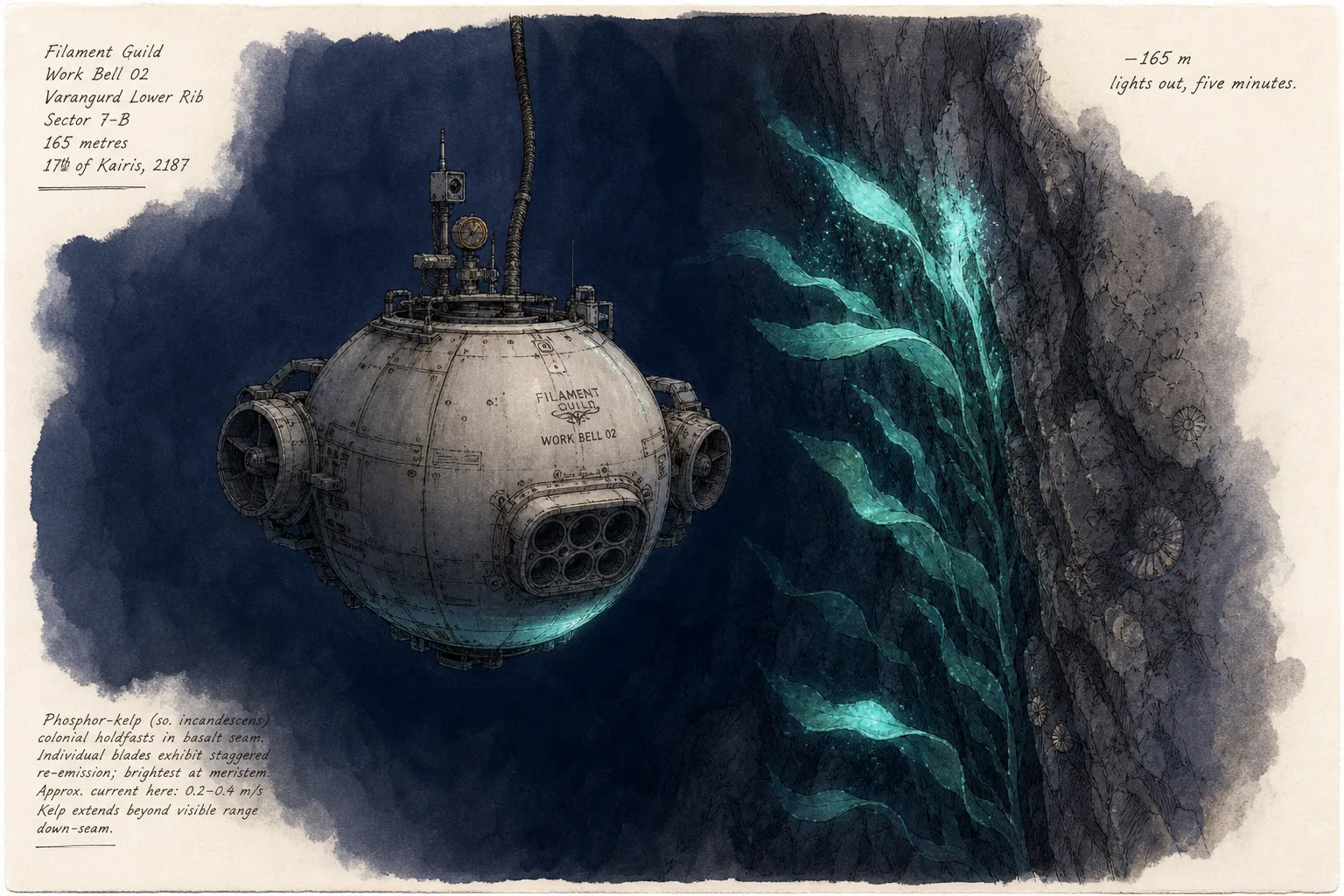
This is the entry I would put into the hands of anyone who asked me what the lower rib is for. The chapter could end here. I wanted it to. The entries that come after this in the larger record are not better than this one; they are only later.
The bell touches the platform at the lower rib at around two in the afternoon, surface time, which down here is a calendar notation and nothing more. The Filament Guild engineer is doing a scheduled maintenance check on the relay junction at this depth — a routine run, maybe three hours, and I have been given a seat on the bell in exchange for a mapping update of the section. Professional courtesy. We do not speak much during the descent.
The rib at one hundred and sixty-five metres is not dramatically different from the rib above. The same dark rock, the same slow current deflecting off the formation, the same geometry of the seabed repeating its argument against surface concerns. What is different is the kelp. Down here the phosphor-kelp grows in the fissures where the rib meets the substrate — long, flat-bladed, a colour that in artificial light reads as grey-green and in no light reads as something else entirely.
The engineer works on the junction for perhaps an hour. I take measurements. We operate in the same space without being in conversation. At one point she hands me a lamp bracket without asking whether I need it held; I hold it. This is how it goes at depth — a social grammar with fewer words.
When she is finished she does something I have not seen before. She reaches to the main work-light cluster on the bell's forward frame and kills all of them at once.
Complete dark. Not the dark of a room with the lights off, which still holds memory of light. This dark is active, absorptive. The hull sounds shift into it.
And then the phosphor-kelp does what it does.
It is not dramatic. The blades do not blaze — they remember, is the better description, re-emitting what the work lights fed them over the last hour in the slow, diminishing way that things release what they are asked to hold. Cold blue-green, moving in the current, each blade at its own pace of fading. The fissures glow like a sentence read in low light.
The blades do not blaze — they remember.
It lasts five minutes. Perhaps a little more.
The engineer turns the lights back on. She makes a note on her board. Neither of us says anything about what we just saw. I do not think she killed the lights for me — she killed them because she wanted to see it too, and I happened to be present, and that is sufficient.
We ascend on schedule. In the bell log I note weather: calm, visibility adequate. I do not note the kelp. Some things are observations, and some things are not for the log.
M. Vael, aboard the bell, Varangurd lower rib.
I have not been able, in the eighteen months since, to decide what the difference is between an observation and a thing-not-for-the-log. I think the difference is a matter of consent, but I am not the one whose consent matters, and I am not sure who is.