IArrival
In this chapter
40 m – 80 m · human
Karrowin Halt
A small human anchorage at the upper shelf margin, lightly maintained and the most accessible of the outer stations to recreational visitors from the surface.
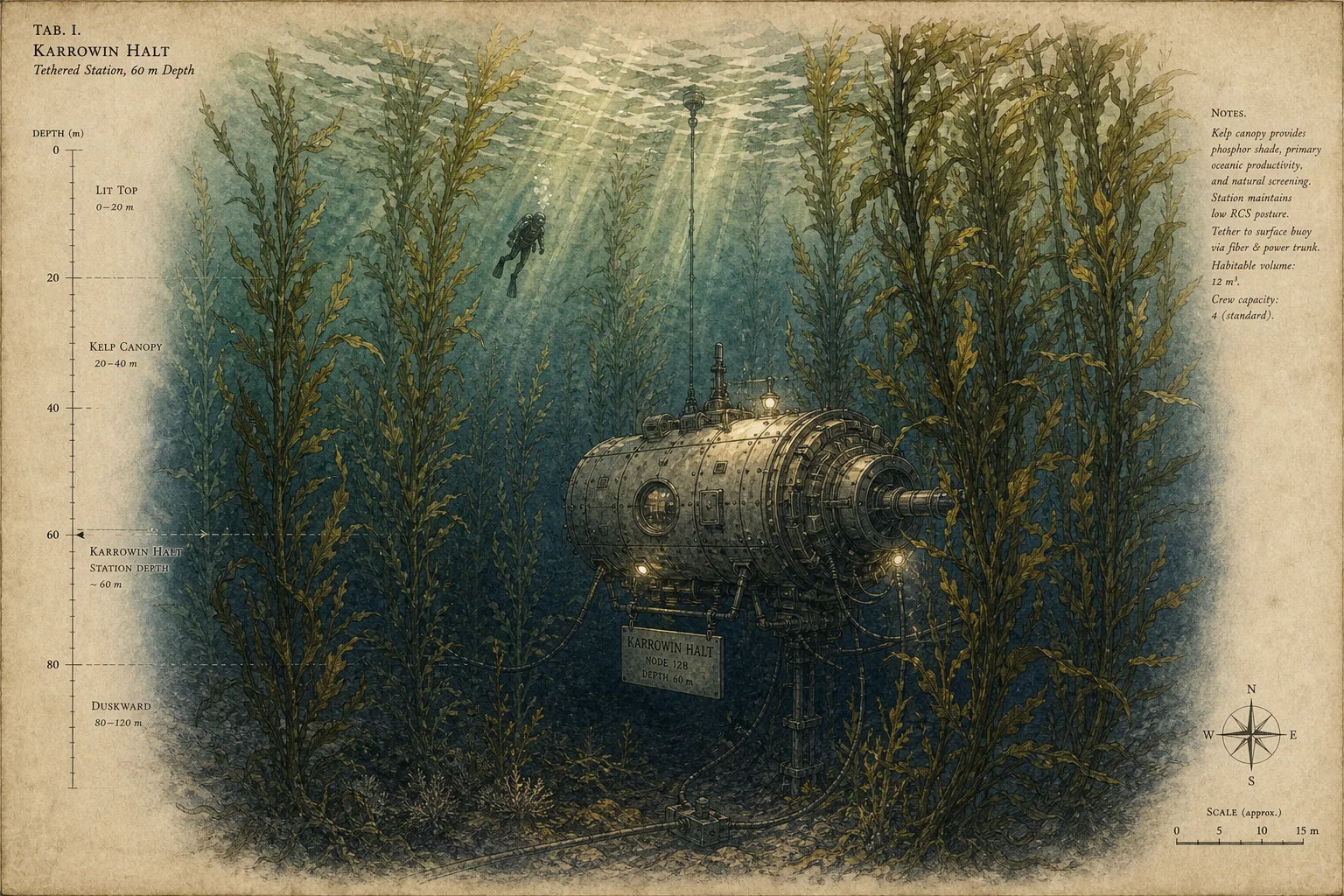
I was briefed at Karrowin three days before my first descent — medical, gear check, trimix ratios, the small ceremonies of being made admissible to a depth — and the entry below is the description I would have wanted before any of that happened. I am still, retrospectively, surprised by how little of the briefing was about the place itself.
Karrowin Halt occupies the shelf edge between forty and eighty metres, where the bottom transitions from structured rock to open sand and the phosphor-kelp thins to scattered individuals. It is the anchorage most often visited by those arriving on recreational certification: the shallowest modules sit at forty-two metres, reachable on single-tank air with adequate planning, and the Halt maintains a surface-contact relay that makes it the safest first stop for divers who have never been below thirty metres before.
The station itself
Four modules, connected by short umbilicals and braced against the shelf with a single mooring cable. The uppermost module is a staging and equipment check area; the three lower modules contain berthing, a small galley, and a communications room. None of it is pressurised to saturation standard — this is technical-diving depth, and visitors arrive and depart on gas rather than through a saturation lock. The Halt can accommodate perhaps twenty overnight occupants at close quarters.
What draws people here
The kelp. The kelp-fanwing nests densely in the phosphor-kelp stands to the south of the mooring, and at dusk the bioluminescent fronds and the hovering feeders are visible from the Halt's external observation rail. Iris-snails graze the mooring cable year-round and are typically the first unfamiliar organism a surface visitor encounters. Neither is rare; both are reliably present.
What the Halt is not
It is not a significant waystation for the deeper routes. Traffic bound for Varangurd Anchorage or below bypasses Karrowin unless weather on the surface approach makes it a necessary shelter. The Halt exists because this depth is accessible and this shelf edge is pleasant, which is a sufficient reason for an anchorage even in the present era.
When I returned to the Halt in the second winter, on a single-tank descent for unrelated reasons, I found the staging module had been re-painted and the equipment racks renumbered. Both changes had been noted in the rotation logbook in a single line. Neither felt like a change.