IArrival
In this chapter
- 1vArrival, the upper rib
- 2vKarrowin Halt
- 3rVarangurd Anchorage
- 3vKelp-fanwing
- 4rKelp-tax dinner
- 5rHelmsward Crossing
- 5vPhosphor on the lower rib
- 6vPhosphor-kelp
2186-02-19 · 110 m
Kelp-tax dinner
The annual Conservancy dinner for contractors at Varangurd Anchorage — kelp, iris snail, saturation air, and a remark that should not have been made.
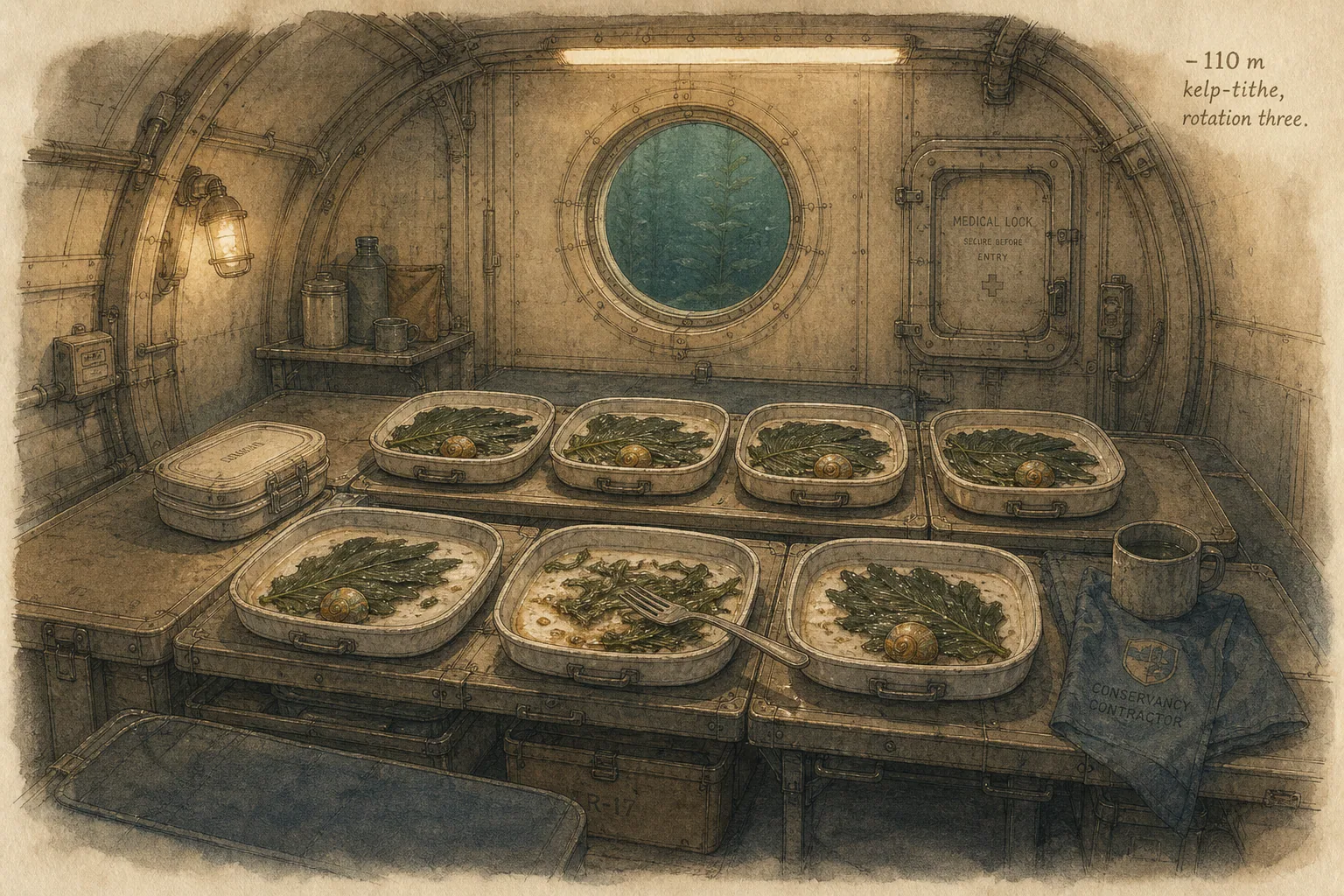
Five months in, and a meal becomes a way of finding out what country you are actually living in. I have rewritten this one less than the arrival entry, partly because the events were small and partly because I am still not entirely sure whose silence I was writing toward.
The kelp-tithe dinner is a Conservancy tradition that predates, I am told, the current charter. Once a year, contractors in saturation at Varangurd Anchorage receive the product of the annual rib harvest — cooked, such as cooking is possible through the medical lock — as a gesture of shared stewardship. It is compulsory in the way that most gestures of shared stewardship are compulsory.
The food arrives in sealed portions, warm enough to be called warm. The kelp-fanwing fronds are steamed into softness that removes almost everything that makes them interesting alive. They are nutritionally serious. They taste of the sea in the way that iron tastes of blood — technically accurate, experientially grim.
The garnish is iris snail. A single iris-snail per plate, shelled and dressed, iridescent even in the cylinder lighting. This is either a delicacy or a demonstration of the lock technician's culinary ambition; I have never determined which. It is the best thing on the plate. This seems to embarrass the Conservancy representative, a younger man doing his first remote liaison rotation, who appears to feel that the garnish should not outperform the tribute.
There are seven of us in the chamber tonight, seated in the configuration that the furniture allows, which is not a configuration designed for a dinner. We eat in shifts, in a polite pantomime of a table. The Bathymetric Conservancy representative gives a short address about sustainable yield and the long view. The long view, at depth, is whatever is directly in front of the porthole.
The conversation that follows is the conversation that always follows institutional meals: logistics, equipment, the reliability of the supply chain, a brief contested argument about whether the pressure cycling affects sleep. By the end there is a comfortable low-level exhaustion that almost resembles warmth.
The Conservancy man opens the second portion. He has been trying to participate in the easy talk and has not quite managed it. He says something about the kelp quota, that the take this year ran slightly over because the southeastern fronds were reclassified. He is filling a silence.
"That's the Filament Guild's section," says the woman across from him.
There is a pause. He knows this. He realises he has implied, by explaining the overage, that he knew it when it happened. He puts his fork down.
"I misspoke," he says.
No one mentions it again.
M. Vael, in the chamber, Varangurd, rotation three.
The Conservancy man's name was not in any list I could later look up, and I have never been able to decide whether that means the system worked or that it did not.