IArrival
In this chapter
30 m – 120 m · flora
Phosphor-kelp
A shelf kelp that produces faint bioluminescence on moonless nights, common near Karrowin Halt and the Lipless Reach and visible to recreational divers in dark-water conditions.
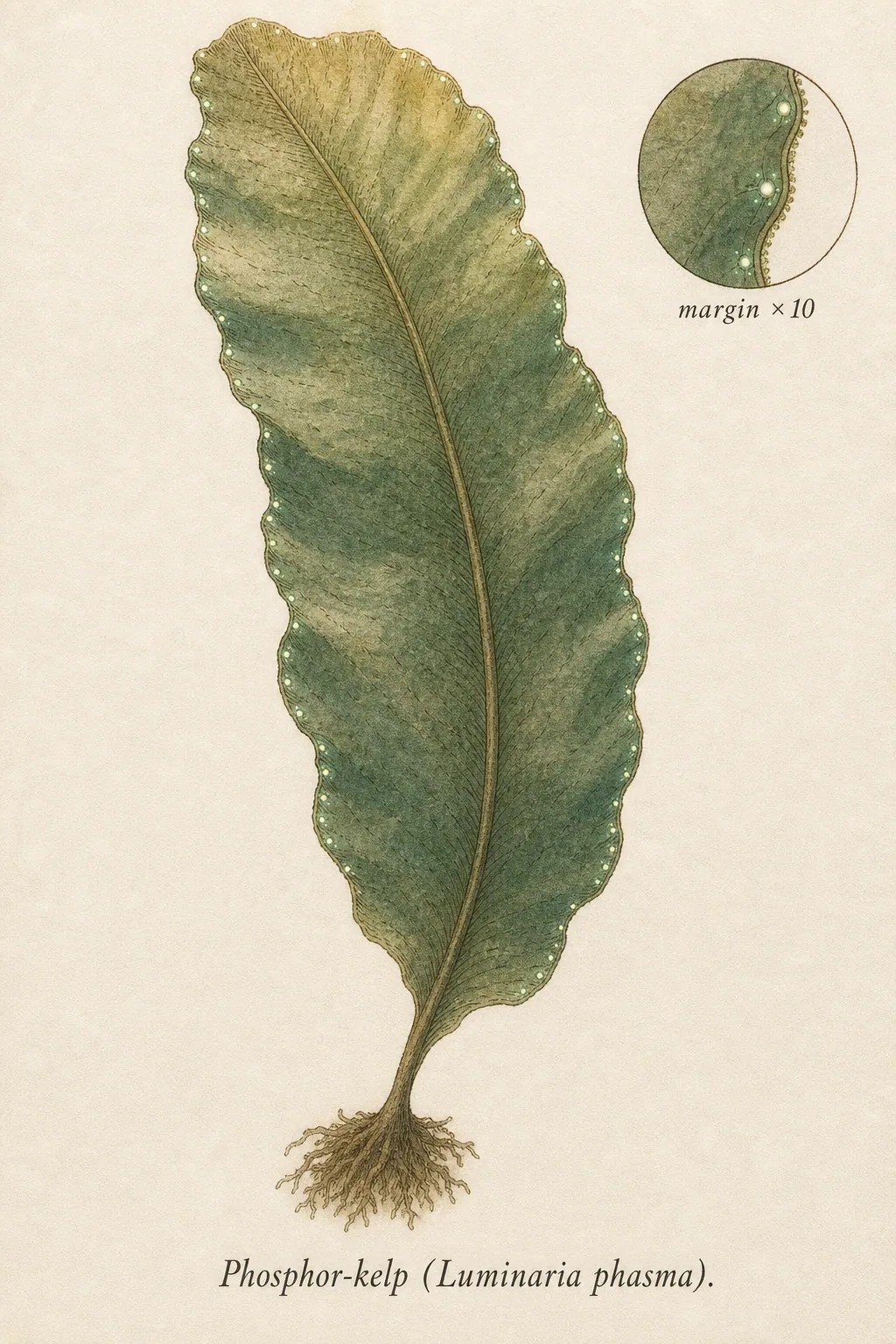
This is the entry I would put alongside the lower-rib journal entry as a single document, if the encyclopedic register tolerated that. The description below is correct. It is also incomplete in ways the description does not know it is incomplete in.
Phosphor-kelp does not light consistently. This is the first thing to understand about it, and the thing most commonly misunderstood by visitors who have seen the photographs. On bright nights, or near any working illumination, it is a kelp: broad blades, olive-brown, attached to the shelf rock by a holdfast that survives considerable surge. On dark nights — specifically on new-moon nights when cloud further reduces ambient input — it produces, from the blade surface, a diffuse blue-white glow. Not bright. Comparable, in the field notes, to watching a wristwatch dial in a dark room.
The bioluminescent mechanism appears to be circadian and lunisolar in trigger, not mechanical. Touching the blade during a non-luminescent period does not produce light; touching it during a luminescent period does not obviously increase it. The light simply occurs, and then, some hours later, does not.
Distribution and habitat
The species is common between thirty and one hundred twenty metres along the outer shelf. Around Karrowin Halt and the Lipless Reach, blade densities are sufficient to produce, on the appropriate nights, a column-wide glow visible from the surface anchorages above. Recreational and technical divers are advised to schedule dark-water dives during new moon periods to observe it; the effect does not replicate under artificial illumination.
Notes
The kelp is a food source. Grazers include the kelp-fanwing and a number of invertebrates. The luminescent mechanism persists in harvested blades for several hours post-separation, which has made it a minor curiosity in the surface settlements. No practical use has been established.
The luminescent mechanism persists in harvested blades for several hours post-separation. I had not known this when I first wrote up the bell entry; I am noting it here because the fact, once known, makes the engineer's gesture different.