IVBeyond the Sun
In this chapter
- 19vThe Black Lung
- 20rEyeless lurker
- 20vThe Trench of Avals
- 21rLampgill anglerfish
- 21vThrough a porthole, Vault of Hours
- 22vThe Vault of Hours
- 23rInk-veiled cephalopod
- 23vGinnungap Trench
- 24rCliff-walker
8,100 m – 8,400 m · wild
Ginnungap Trench
A hadal trench reaching to eight thousand four hundred metres, visited twice in the past decade by DSV expedition and otherwise uncharted below the abyssal approaches.
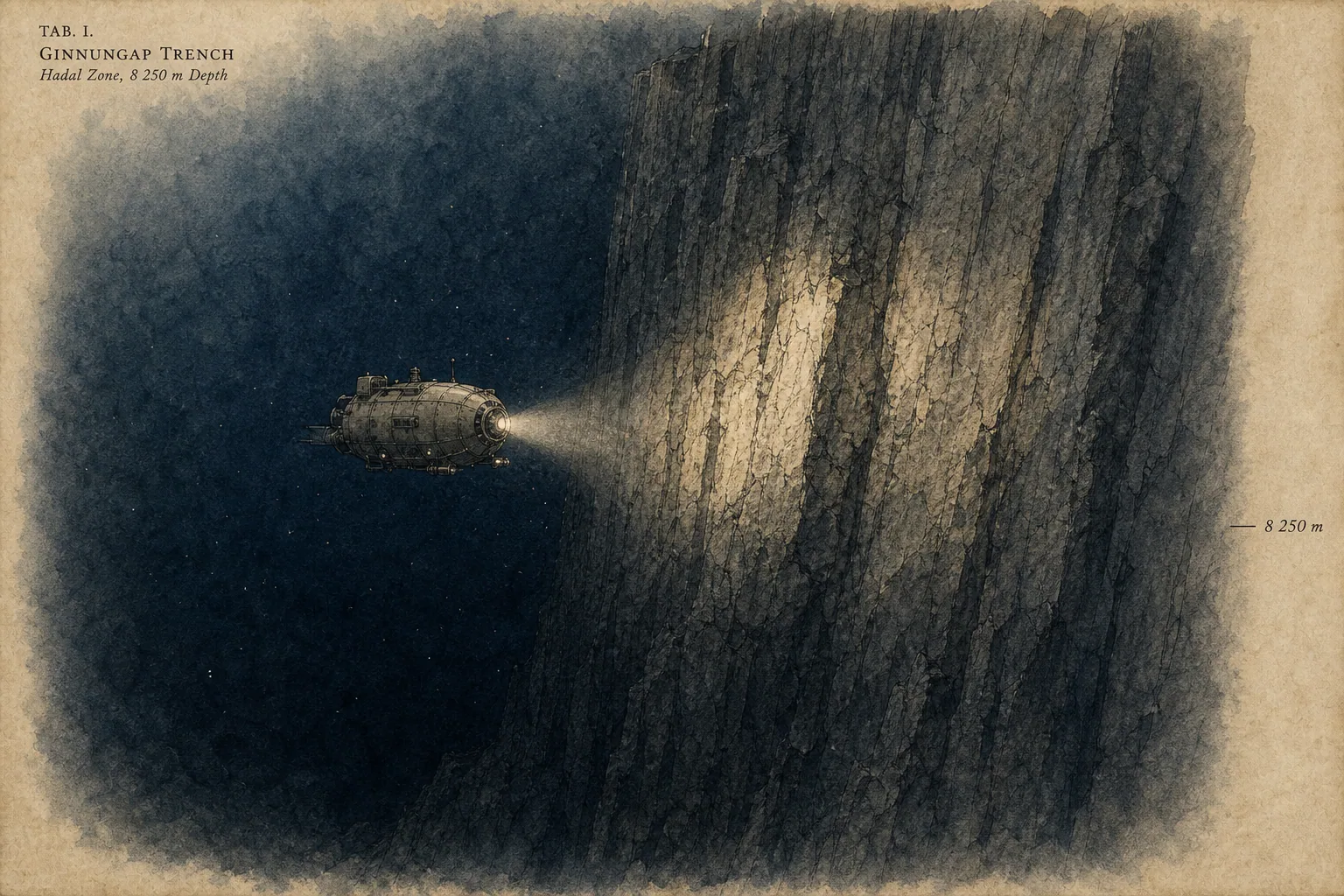
Ginnungap I have not been to. Below eight thousand metres the vehicles are full-ocean-depth DSVs, and the trench has been reached twice in the past decade — neither pass mine. What I record here is a paraphrase of the published expedition data and of the partially unpublished single-vehicle pass, with care taken to distinguish what was observed from what the instruments were merely capable of reaching for.
Ginnungap is hadal territory. Below eight thousand metres the water column is the exclusive domain of crewed DSVs rated for full-ocean depth, and there are perhaps a dozen vessels in current operational service that qualify. The trench has been reached twice in the past ten years: once by a joint Conservancy-independent survey expedition in the earlier part of the decade, and once by a single-vehicle pass whose data remains partially unpublished.
What can be said
The trench floor at approximately eight thousand one hundred metres is sedimentary, flat-bottomed over the sections surveyed, with a pressure of roughly eight hundred atmospheres. The walls above the floor, where the trench narrows, are documented only to the degree that the expedition's lights and instruments reached — which is to say, partially. Cliff-walkers were observed on both passes along the upper reaches of the trench walls, above approximately six thousand metres; whether they descend into the hadal zone proper is not established.
The name
Ginnungap is not an official designation in the Conservancy's naming registry. It appears in the first expedition's field log as a notation by one of the crew and was adopted in the published survey without comment. The name has since been used in all subsequent references and has not been challenged.
What is not known
Whether it is inhabited. The survey instrumentation detected no acoustic signature attributable to Pelagine activity on either pass, but detection limits at hadal depth in an unexplored trench are significant. Absence of signal is not absence.
Detection limits at hadal depth are significant. I have learned to treat absence of signal, in places like this, as a property of the instrument before it is a property of the trench.