IVBeyond the Sun
In this chapter
- 19vThe Black Lung
- 20rEyeless lurker
- 20vThe Trench of Avals
- 21rLampgill anglerfish
- 21vThrough a porthole, Vault of Hours
- 22vThe Vault of Hours
- 23rInk-veiled cephalopod
- 23vGinnungap Trench
- 24rCliff-walker
4,000 m – 6,000 m · fauna
Lampgill anglerfish
Lumenacanthus profundus
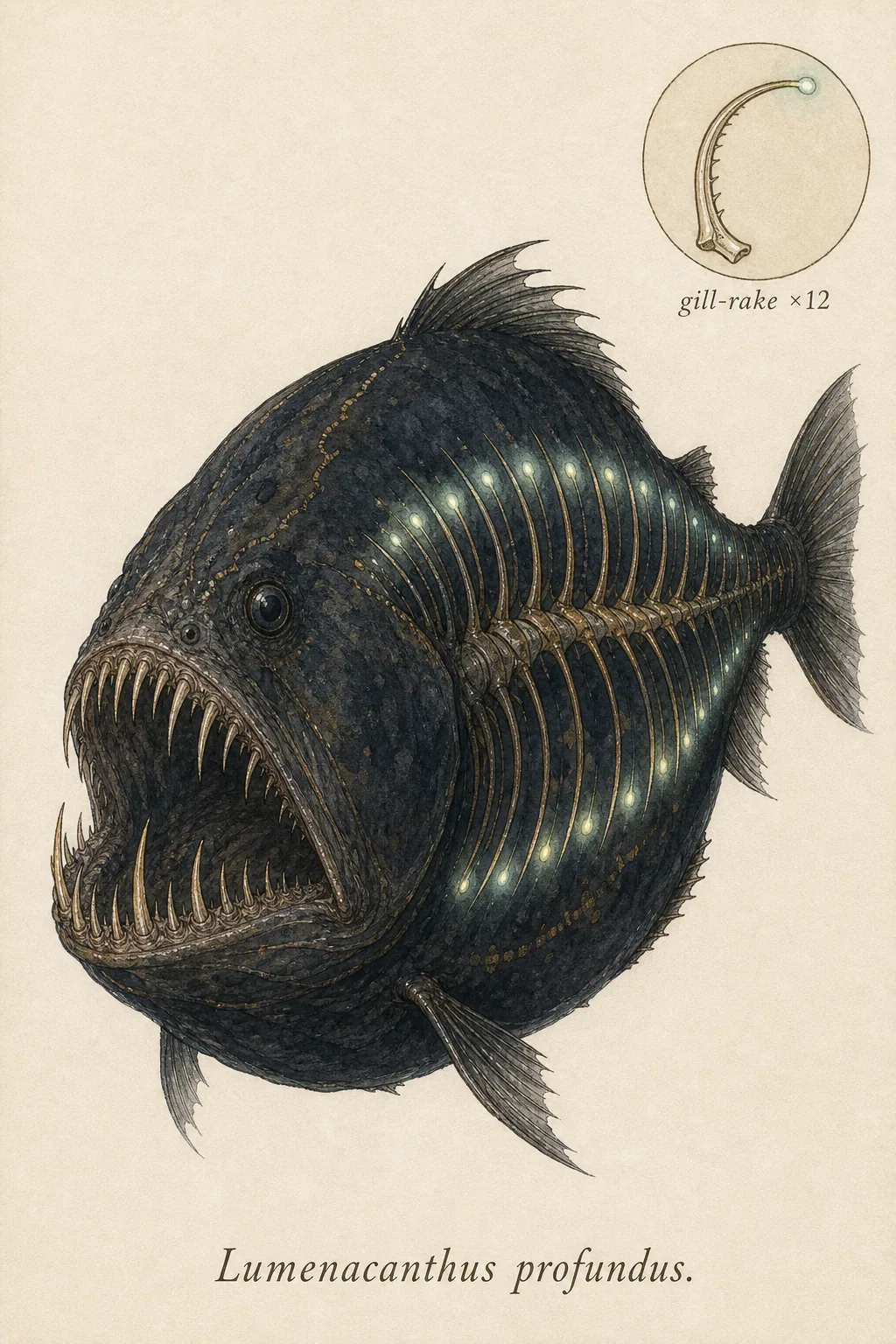
The lampgill is the first animal in this chapter that I have only read in the survey notes — I have not been at four thousand metres with a window onto a basalt shelf. I include it because the survey's word for its behaviour is patient, which I have rarely seen used about an animal without sentiment, and which appears to be accurate. The light pulses with the breath. The animal waits.
The lampgill anglerfish does not fit the template. It produces light from its gill-rakes — the comb-like structures lining the gill arches — and not from the modified dorsal spine that characterises the order's most-familiar representatives. When the fish breathes, light pulses. Whether this is by design or a side effect of gill ventilation is unresolved.
Lumenacanthus profundus was first documented at four thousand three hundred metres in the eastern reach of the midnight zone, by a survey submersible hovering against a basalt shelf. The pilot noted it as a glowing crevice that, after some time, moved. It averaged perhaps thirty centimetres in body length; the mouth, when opened in the documented encounter, accounted for roughly half of that.
Anatomy
The body is compressed and deep-chested for an anglerfish, with a large cranium and a jaw that disarticulates significantly. The gill-rakes are bilaterally visible as faint bars of blue-green light along the jaw line when the animal is at rest. Stomach capacity is, by dissection of one recovered specimen, very large relative to body size. The animal appears to carry its own neutral buoyancy; it does not use the substrate.
Behaviour
Patient. This word recurs in survey notes and is, upon reflection, accurate: the lampgill holds position for extended periods, gill-light cycling, in water that appears to contain nothing. What it waits for — what passes at six kilometres that a lampgill considers food — the survey does not claim to know. One specimen was recovered with contents that included fragments of a species not yet described.
Whatever the lampgill is waiting for at six kilometres, the survey does not claim to know. One specimen carried, in its stomach, a fragment of a species not yet described. I leave that here as it was given to me.