IVBeyond the Sun
In this chapter
- 19vThe Black Lung
- 20rEyeless lurker
- 20vThe Trench of Avals
- 21rLampgill anglerfish
- 21vThrough a porthole, Vault of Hours
- 22vThe Vault of Hours
- 23rInk-veiled cephalopod
- 23vGinnungap Trench
- 24rCliff-walker
1,500 m – 3,500 m · fauna
Ink-veiled cephalopod
Tenebrovola noctivaga
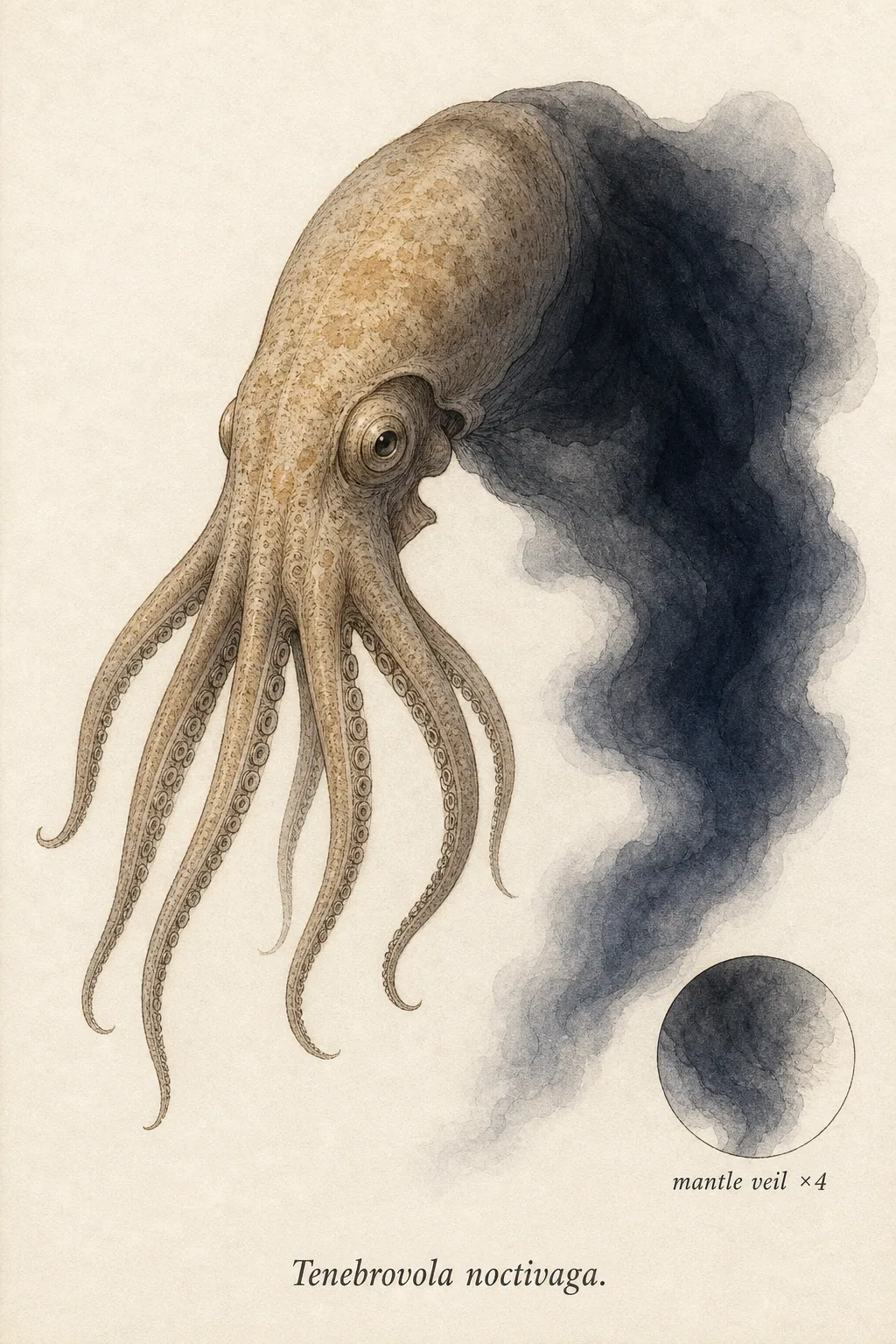
Tenebrovola I have observed once, from the submersible, near the outer approaches to the Silent Chord. The first thing to record is that the ink does not spread. It hangs. The second is that the animal observes the approach before deploying it — observes is the word that comes to mind, and I will not pretend a better one is available. When the veil is up, the animal is gone.
The ink of Tenebrovola noctivaga does not spread. This is the first and most disorienting observation. In all other inked cephalopods known to the survey, the ink disperses — a cloud, a smear, a confusion of boundaries. The ink-veiled cephalopod releases a curtain that hangs. It is dark in a way that exceeds the darkness behind it. The submersible's light does not penetrate it; instruments suggest it absorbs across a wider spectrum than pigment alone should account for.
The animal has been observed near the Silent Chord on seven separate survey dives. Whether this is habitat preference, coincidence, or something more specific to the Chord's acoustic environment is not established.
Anatomy
Body length of observed individuals ranges from forty to ninety centimetres excluding tentacles. The mantle has a matte surface that reflects poorly across the visible spectrum — before the veil is deployed, the animal is already difficult to locate by eye. Eight arms and two tentacles; the tentacles are proportionally longer than the arms and carry suckers in irregular rather than paired rows. The ink gland is noticeably enlarged relative to comparably sized cephalopods.
Behaviour
When approached, Tenebrovola does not immediately retreat. It observes — this is the word that comes to mind — and if the approach continues, it deploys the veil in a single pulse. The veil persists. The animal is gone when it dissipates. That the animal is intelligent in some operational sense seems likely; that this intelligence is comparable to, or communicable with, the Pelagine intelligences recognised by the survey is far from certain.
I note, without elaborating, that the response to being watched is to make oneself less observable. Whether this is intelligence in the operational sense, or instinct in a particularly elegant arrangement, the survey is not equipped to decide.