IVBeyond the Sun
In this chapter
- 19vThe Black Lung
- 20rEyeless lurker
- 20vThe Trench of Avals
- 21rLampgill anglerfish
- 21vThrough a porthole, Vault of Hours
- 22vThe Vault of Hours
- 23rInk-veiled cephalopod
- 23vGinnungap Trench
- 24rCliff-walker
1,050 m – 1,200 m · wild
The Black Lung
A methane vent field on the deep shelf floor, observable only by submersible and host to extremophile communities that include tide-coral formations and resident mantle-singers.
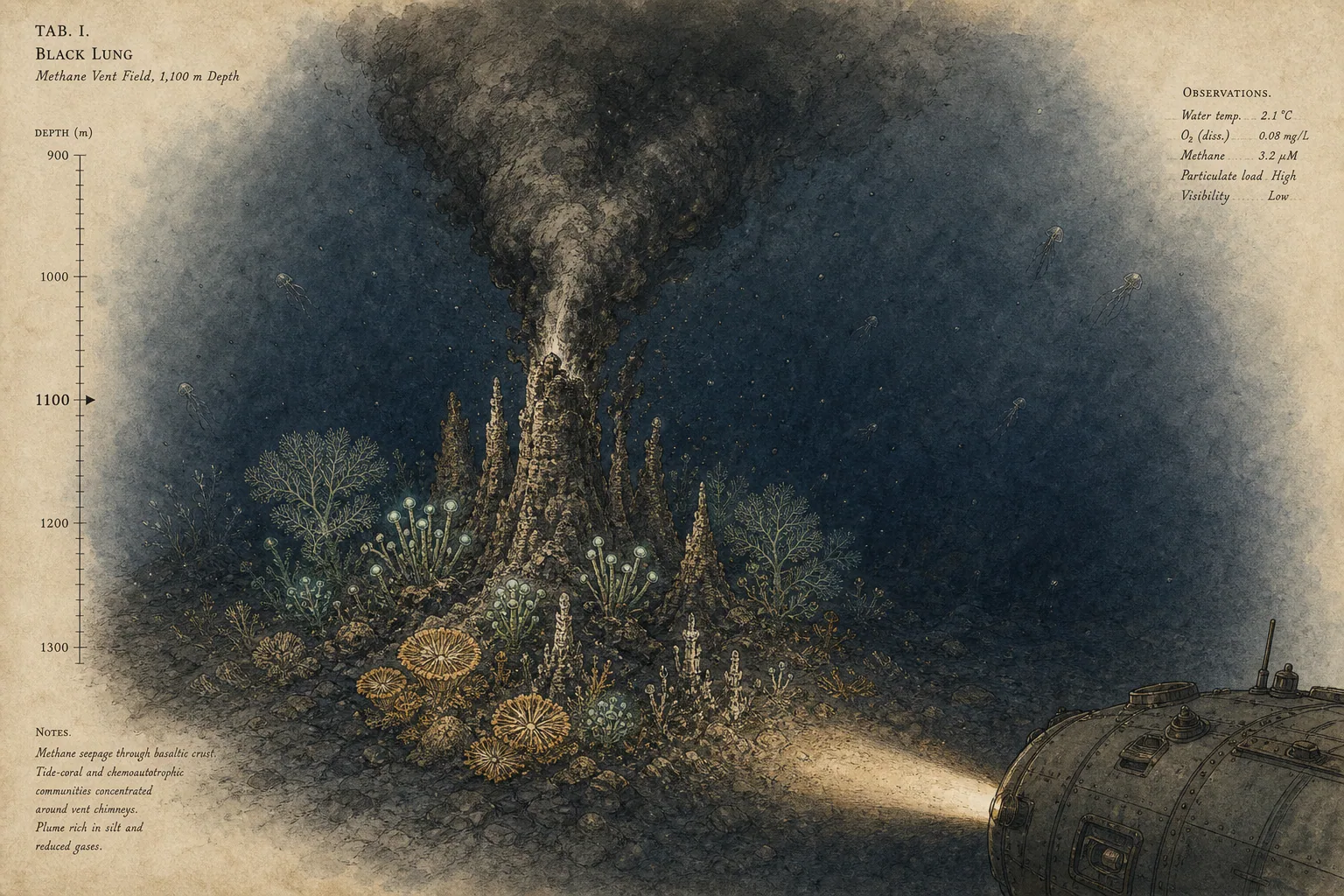
I have only seen the Lung from a submersible window, and only at a distance the pilot considered prudent. At a thousand metres the field is not a place a human visits; it is a column of instrument readings that resolves, on the porthole side, into a slow respiration of pale gas against pale mat. I include it here because it is the shallowest entry of this chapter and the one closest to a depth a body could, in principle, occupy — though no body does.
The Black Lung is a field of active methane vents occupying a section of soft seafloor between one thousand fifty and one thousand two hundred metres. The name refers to the gas, not to anatomy: the vents exhale in irregular pulses, and a submersible hovering above the field at distance records the expulsions as a slow, arhythmic respiration visible in the instrument data before it is visible through the porthole. There are no humans in the water here, and no reason for any.
The vent field
Approximately two hundred and forty individual vent points have been mapped across the field's extent, grouped into clusters of three to twenty. Gas composition: predominantly methane, with minor hydrogen sulfide and carbon dioxide fractions that instruments detect well before any biological indicator does. The seafloor around active vents is pale with microbial mat, and tide-coral has colonised the mat margins in formations that grow dense and low rather than branching upward, as if pressed down by the gas rising around them.
The mantle-singers
Mantle-singers are present in the water column above the field at most survey passes. Whether they are here for the vent chemistry, for the organisms the vents support, or for some property of the field not captured by the survey instrumentation is not established. They do not appear to descend to the seafloor. They call, and the calls are recorded, and the recordings are held by the Conservancy's biological archive, unanalysed.
What the Lung is not
It is not a Pelagine site. No Pelagine structure has been documented within or adjacent to the field, and the Tyrian Court, when the field was mentioned in a contact session at the Brassgate, offered no comment that the human interpreters were able to parse.
The recordings of the singers above the field are held, unanalysed, in the Conservancy archive. I have not asked to listen to them. I am not sure I would know what to do with the listening.