IVBeyond the Sun
In this chapter
- 19vThe Black Lung
- 20rEyeless lurker
- 20vThe Trench of Avals
- 21rLampgill anglerfish
- 21vThrough a porthole, Vault of Hours
- 22vThe Vault of Hours
- 23rInk-veiled cephalopod
- 23vGinnungap Trench
- 24rCliff-walker
4,000 m – 8,500 m · fauna
Cliff-walker
Scopocrabis ascendens
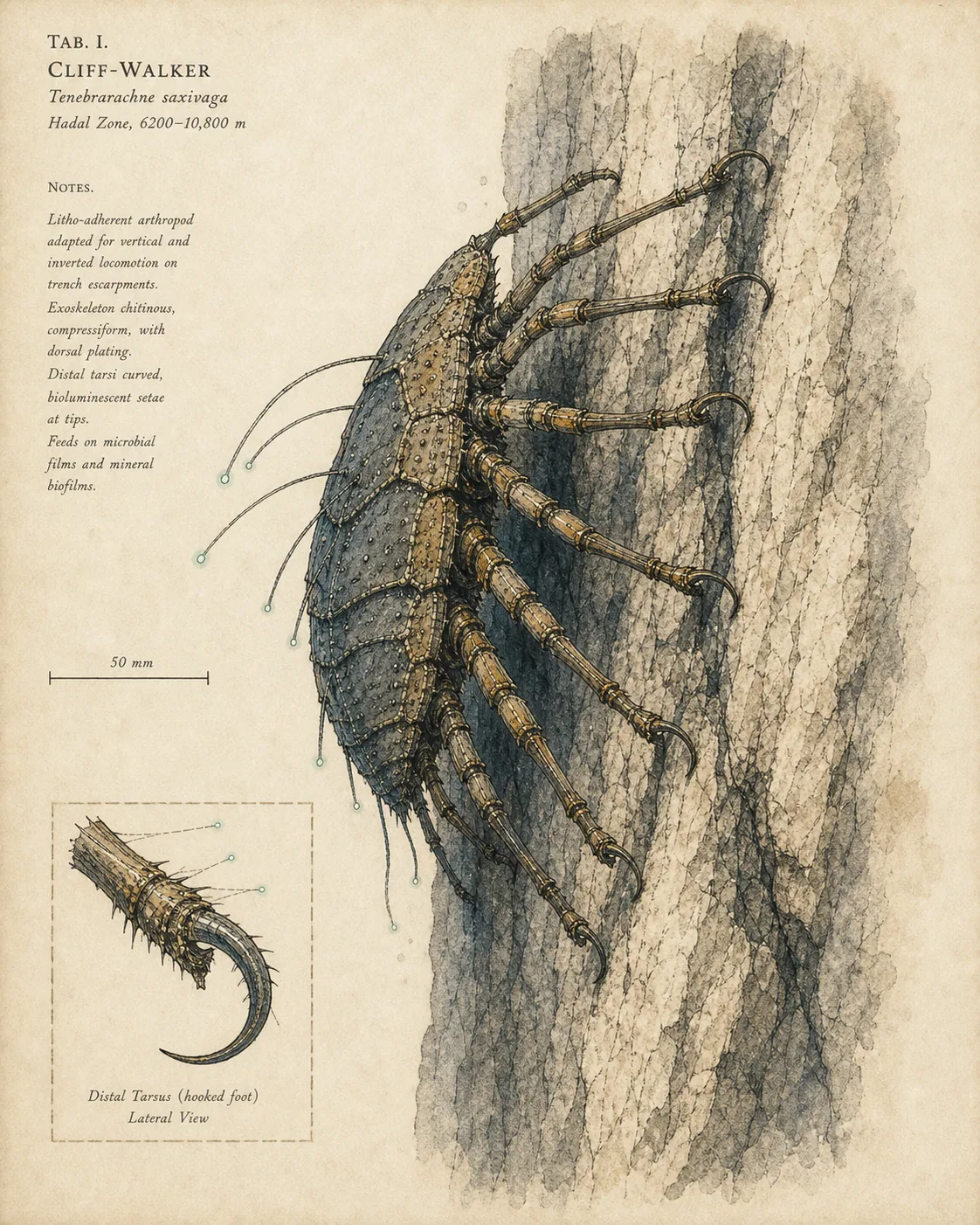
The cliff-walker is the closing entry of the chapter and the only organism here whose range crosses the Midnight floor into the hadal proper. I have not seen one. The two confirmed Ginnungap encounters belong to other crews, and what I record below is paraphrased from their frame logs. The animal walks the wall. It does not swim. It does not detach. In the second-pass record, one individual is visible across multiple frames, having moved perhaps twenty centimetres between the first and the last.
Scopocrabis ascendens is one of very few animals whose range the survey has confirmed across both the Midnight and Hadal zones. Most hadal fauna is bounded below the hadal rim and does not ascend; most midnight fauna does not descend past the Midnight floor. The cliff-walker does both. It is found on vertical surfaces at four thousand metres and, in fewer confirmed observations, at eight thousand five hundred. What it does in the kilometres between is not known, but the survey assumes it walks.
The animal's name is a description. It clings to rock walls. It moves along them. It does not, in observed encounters, swim, drift, or detach voluntarily.
Anatomy
Body length in confirmed specimens ranges from thirty to ninety centimetres. The body is dorso-ventrally flattened, with a broad anchor-claw at each limb terminus adapted to surface grip on rough and smooth rock alike. Fourteen ambulatory limbs have been counted in complete specimens. There are no functional eyes; sensory organs appear to be chemoreceptive and pressure-sensitive. The exoskeleton is markedly thick relative to body mass — thicker at depth, in specimens recovered from Ginnungap, than in those taken at four thousand metres, suggesting developmental adaptation across the range.
Ginnungap observations
The Ginnungap Trench presents access challenges that have limited documentation to four hadal expedition passes. On two of these, cliff-walkers were observed on the trench wall at eight thousand to eight thousand five hundred metres. They did not respond to illumination. They were not disturbed by the vehicle's passage. In the record from the second pass, one individual is visible in the background of multiple frames, having moved perhaps twenty centimetres between the first and last.
Twenty centimetres, across however long the lights were on it. This is, I think, the appropriate pace for the depth. The chapter ends here because the survey has nothing more to offer it.