IVBeyond the Sun
In this chapter
- 19vThe Black Lung
- 20rEyeless lurker
- 20vThe Trench of Avals
- 21rLampgill anglerfish
- 21vThrough a porthole, Vault of Hours
- 22vThe Vault of Hours
- 23rInk-veiled cephalopod
- 23vGinnungap Trench
- 24rCliff-walker
2187-09-30 · 3,805 m
Through a porthole, Vault of Hours
A submersible observation of the Tyrian Court's Vault of Hours — its lights, its vault-eels at the gate, and the plumed gulpers beyond — and what it means to see an archive from outside.
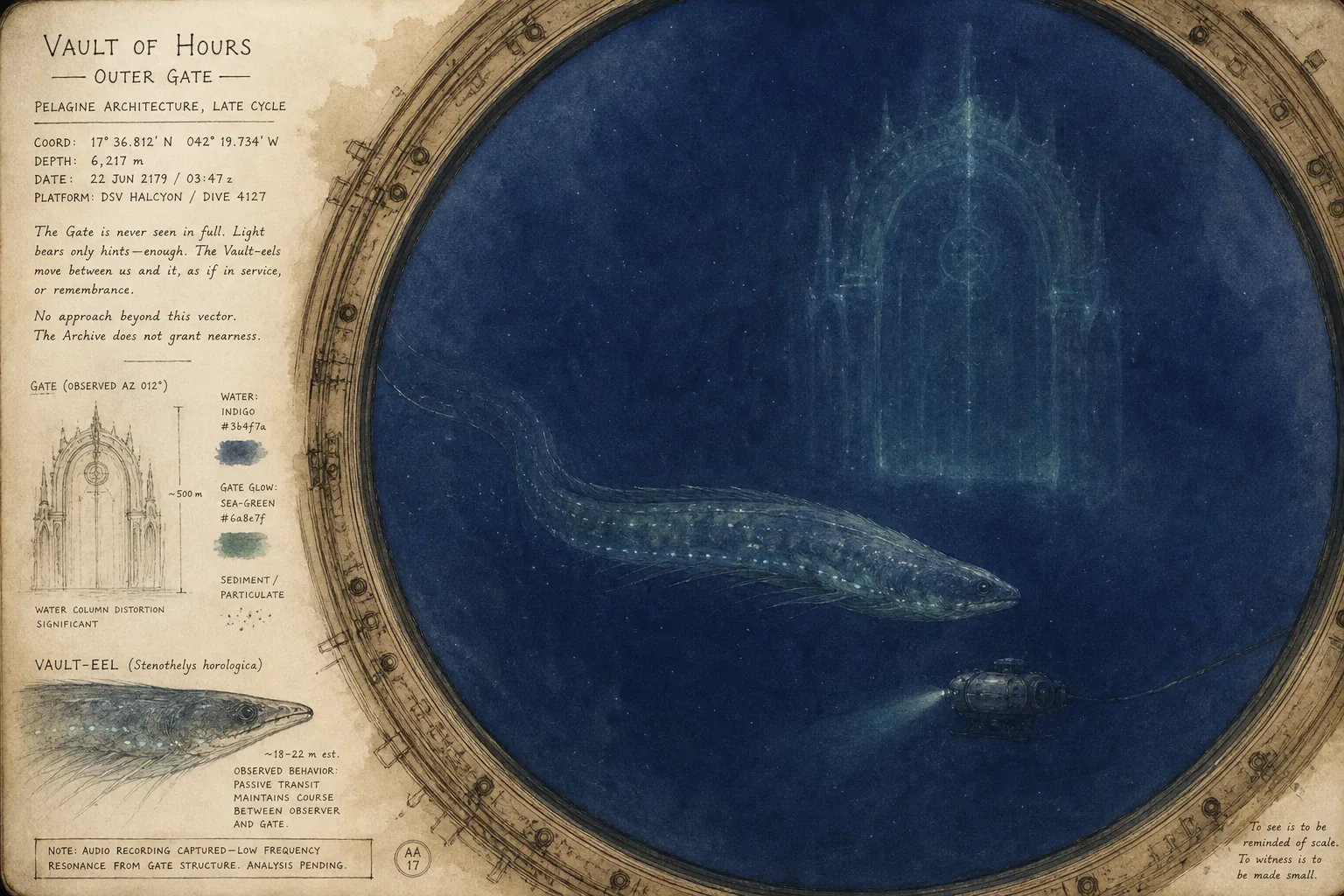
This is the entry I include reluctantly, because it is the one in which I do the least and observe the most. Three hundred metres off the outer gate is as close as the protocol permits, and at that distance the body becomes incidental — a pressure signature behind a pane of acrylic. What follows is what the porthole gave me and what I have been able to keep from making it stand for more.
The pilot brings us to within three hundred metres of the outer gate and holds position there, which is as close as the approach protocol permits. The Vault of Hours shows itself slowly — first as a pattern of low lights that the brain tries to read as a settlement and then reclassifies as something more deliberate. Not a settlement. An installation. The distinction is legible even at this distance.
At this depth I am inside the hull, behind glass, which is the only way the body is at this depth. This is not a complaint. The porthole is generous. The pilot has positioned the floods so that our light falls short of the Vault's perimeter, and we sit in a relative darkness that makes the Vault's own illumination easier to read.
The vault-eels are at the outer gate in numbers I cannot precisely count — a dozen, perhaps more, moving in the slow vertical oscillation that seems to be their resting state. They are large, individually, and as a group they constitute something that reads as intentional. Whether the Court cultivates them or simply benefits from their presence is a question I have seen debated at length in the liaison documentation without resolution. Either way, the gate is attended.
Farther out — perhaps fifty metres past the perimeter, drifting through the edge of the Vault's light — two plumed-gulpers move in long arcs. They are not interested in us. At this depth, most things are not interested in us; we are a light source and a pressure signature, and they have calibrated their lives around more interesting events.
I watch through the porthole for a long time.
The Vault is an archive. I know this from the liaison briefings, from the Conservancy's summary documents, from a paper I read four years ago and have not been able to fully forget. It holds records — Pelagine records, in formats and media I have no access to — across a span of time that makes the surface archival tradition feel recent. What it means to see it, from here, is harder to hold onto.
Archives, in my experience, are rooms full of boxes in corridors I have not been given permission to enter. This is not metaphorical; I mean that literally. Most of my contract access to the Court's materials has been through summary documents and certified translations, and the gap between what I can access and what is held is not a matter of bad faith — it is a matter of scale. The Vault is not withholding. It is simply much larger than what I can receive.
The pilot asks if I want more time.
I say yes. A few more minutes.
The eels oscillate. The gulpers complete their arcs and begin again. The lights of the Vault do not vary. This is not a place that is waiting for us to arrive.
This is not a place that is waiting for us to arrive.
M. Vael, aboard the survey submersible, standing off the Vault of Hours.
I have re-read this entry twice and edited only the punctuation. The Vault is not waiting for us to arrive. I had thought, before going, that I would feel that as an injury. I did not.