VThe Returning
In this chapter
- 25vBoneward, in winter
- 26vThe Boneward
- 27rLethewards Drift
- 27vThe Reliquary at Pell
- 28rGlass-shawl medusa
- 28vTender north, surface day
- 29vThe Lipless Reach
- 30rThe Surfaceborne
- 30vPlumed gulper
30 m – 90 m · contested
The Lipless Reach
A drowned coastal stretch at recreational and technical diving depth, used as a site of pilgrimage by the Surfaceborne and surveyed intermittently by the Conservancy.
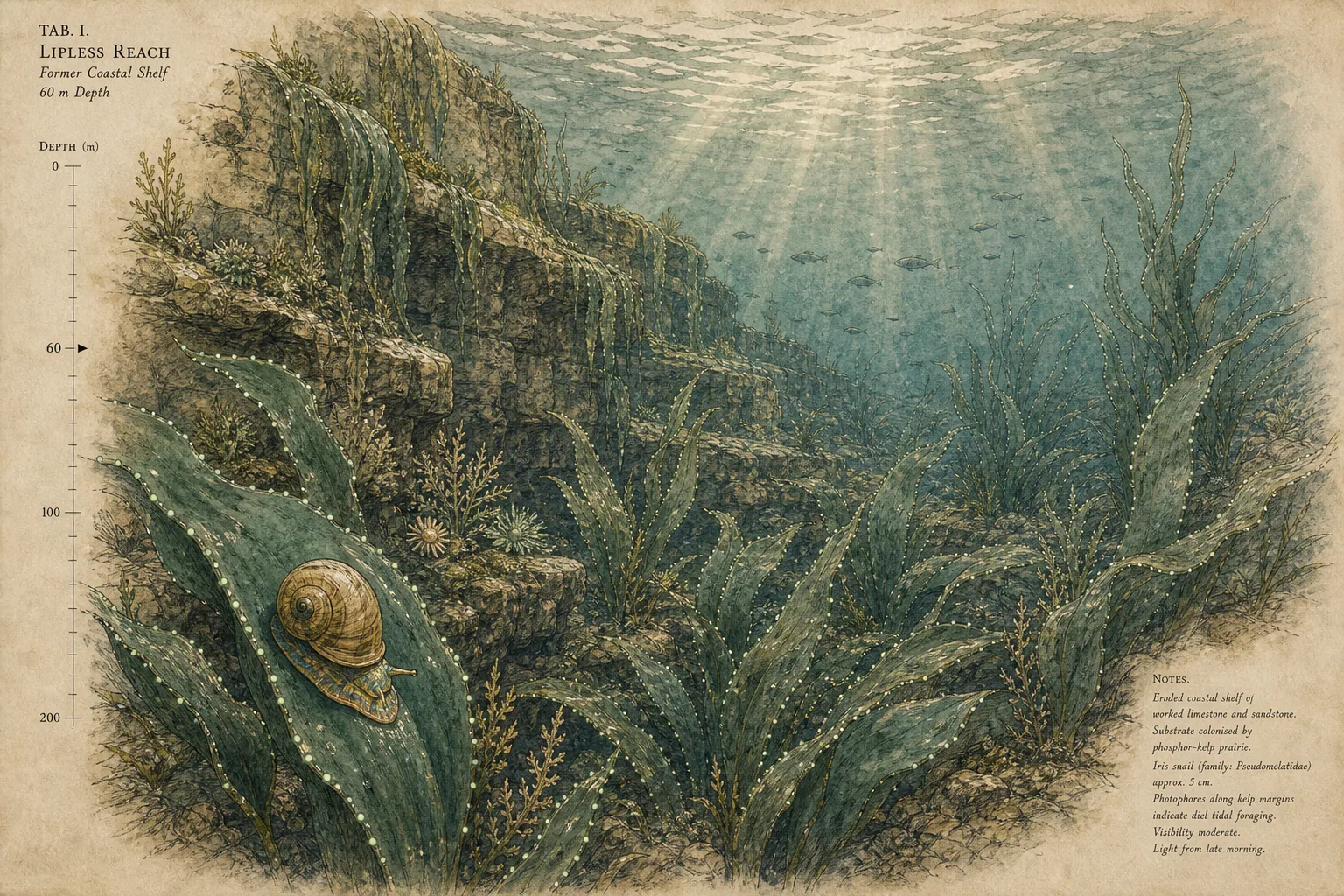
A drowned coast at depths a recreational diver can reach, which is unusual in the archive and consequential. The Surfaceborne call it the Lipless Reach; the Conservancy calls it Survey Grid 7-Coastal-West. Neither designation is authoritative and I have learned to use both, depending on whom I am writing for.
The Lipless Reach is the name given by the Surfaceborne to a stretch of former coastline running for approximately thirty kilometres along a shelf that now lies between thirty and ninety metres. The name is not on any Conservancy chart; the Conservancy's documentation refers to the same area as Survey Grid 7-Coastal-West. Both designations are in common use, and neither is considered the authoritative one.
The site
At thirty to sixty metres the drowned coast is accessible on mixed-gas technical diving: decompression mandatory, certification required. The shallowest features — old seawalls, the upper stories of the tallest former structures — reach to within thirty metres of the surface and are within recreational range for qualified divers. Phosphor-kelp has colonised most of the intact walls. Iris-snails are abundant on every hard surface, their shells visible as persistent pale lines on the stonework from a metre's distance.
Pilgrimage
The Surfaceborne bring the dead here, or bring objects associated with the dead, or bring nothing and stay for a prescribed interval. The practice varies by lineage and is not uniform. The Conservancy does not interfere with Surfaceborne access periods, which are loosely seasonal, and maintains a standing agreement that survey operations will not overlap with announced pilgrimages.
What the Reach preserves
Structural collapse is uneven: some facades stand to near-original height; others have compressed to rubble that only sonar distinguishes from natural reef. The site is not maintained. What the sea has taken, it has taken; what it has left is what remains. The phosphor-kelp does not distinguish between memorial and substrate.
The phosphor-kelp does not distinguish between memorial and substrate. I have copied that sentence forward into other entries and it has refused, each time, to settle into being a metaphor.