VThe Returning
In this chapter
- 25vBoneward, in winter
- 26vThe Boneward
- 27rLethewards Drift
- 27vThe Reliquary at Pell
- 28rGlass-shawl medusa
- 28vTender north, surface day
- 29vThe Lipless Reach
- 30rThe Surfaceborne
- 30vPlumed gulper
80 m – 110 m · contested
The Reliquary at Pell
A flooded cathedral at technical diving depth, held as a relic by the Surfaceborne and the most-documented ruin in the current archive.
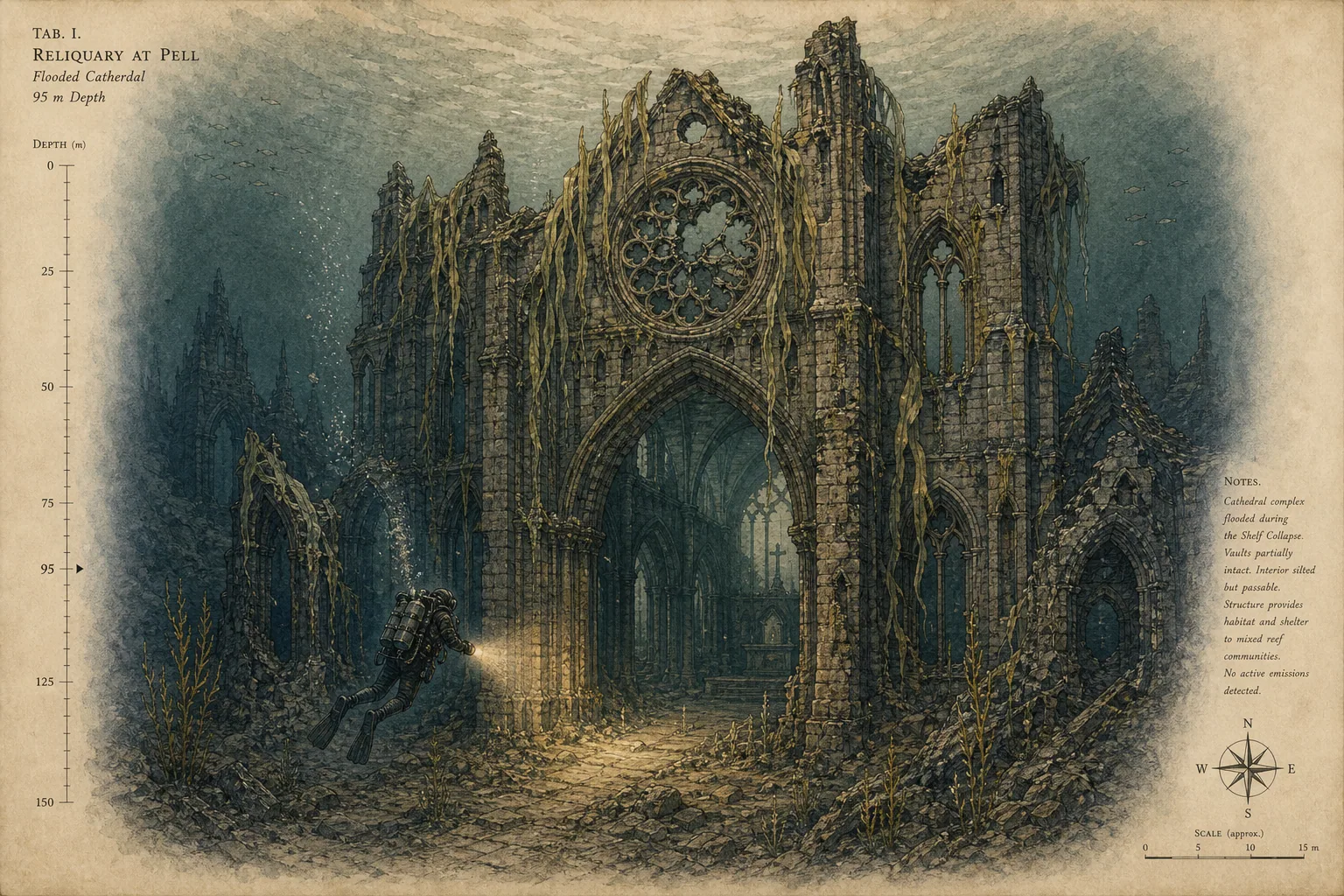
The most-photographed ruin in the current archive, and the one I have written most carefully. The Surfaceborne regard Pell as theirs; the Conservancy has surveyed it more times than any other ruin we hold. Both are correct in different ways, and I have tried to keep both positions on the page without resolving them.
Pell Cathedral was a large masonry structure on a coastal promontory. The sea took the promontory over several decades; the cathedral, better-built than most, descended slowly enough that its nave and transepts remain largely intact between eighty and one hundred ten metres. The Surfaceborne regard it as theirs, though by what mechanism of claim is not formalised. The Conservancy has surveyed it more times than any other ruin in the current archive. Both are, in different ways, correct.
The structure
At eighty metres the cathedral's west tower is still standing to approximately two-thirds of its original height. The nave roof has held. The clerestory windows are frameless — the glass long gone, the stonework intact — and kelp-fanwing pass through them freely, nesting in the vaults above the nave floor. At one hundred ten metres, the choir and apse sit in permanent dimness. Mixed-gas technical divers on decompression profiles can reach the apse and return; the approach is standard for the depth but not trivial.
Why it is photographed
Mostly because it is visually legible. Most ruins at this depth are ruin in the geological sense — rubble, sediment, hard to read as having been human. Pell is still recognisably a cathedral: nave, transepts, vaulting. A diver can orient within it by architecture, which is rare, and the combination of the intact stonework, the kelp-fanwing, and the artificial light creates the kind of image that circulates widely. The Conservancy has asked, more than once, that the Surfaceborne coordinate access schedules to manage traffic. Coordination has been partial.
The Surfaceborne presence
The Surfaceborne maintain a seasonal access node above the cathedral site, not inside it. Their use of the Reliquary is not liturgical in any form the Conservancy's observers have been able to identify. They come; they descend; they remain for an interval; they ascend. What passes during that interval has not been recorded, because the Surfaceborne have not invited recording, and the Conservancy does not record uninvited.
What passes during a Surfaceborne interval at Pell has not been recorded, because they have not invited recording. I have made my peace with not recording it either.