VThe Returning
In this chapter
- 25vBoneward, in winter
- 26vThe Boneward
- 27rLethewards Drift
- 27vThe Reliquary at Pell
- 28rGlass-shawl medusa
- 28vTender north, surface day
- 29vThe Lipless Reach
- 30rThe Surfaceborne
- 30vPlumed gulper
1,200 m – 3,500 m · fauna
Glass-shawl medusa
Vellumina pelagica
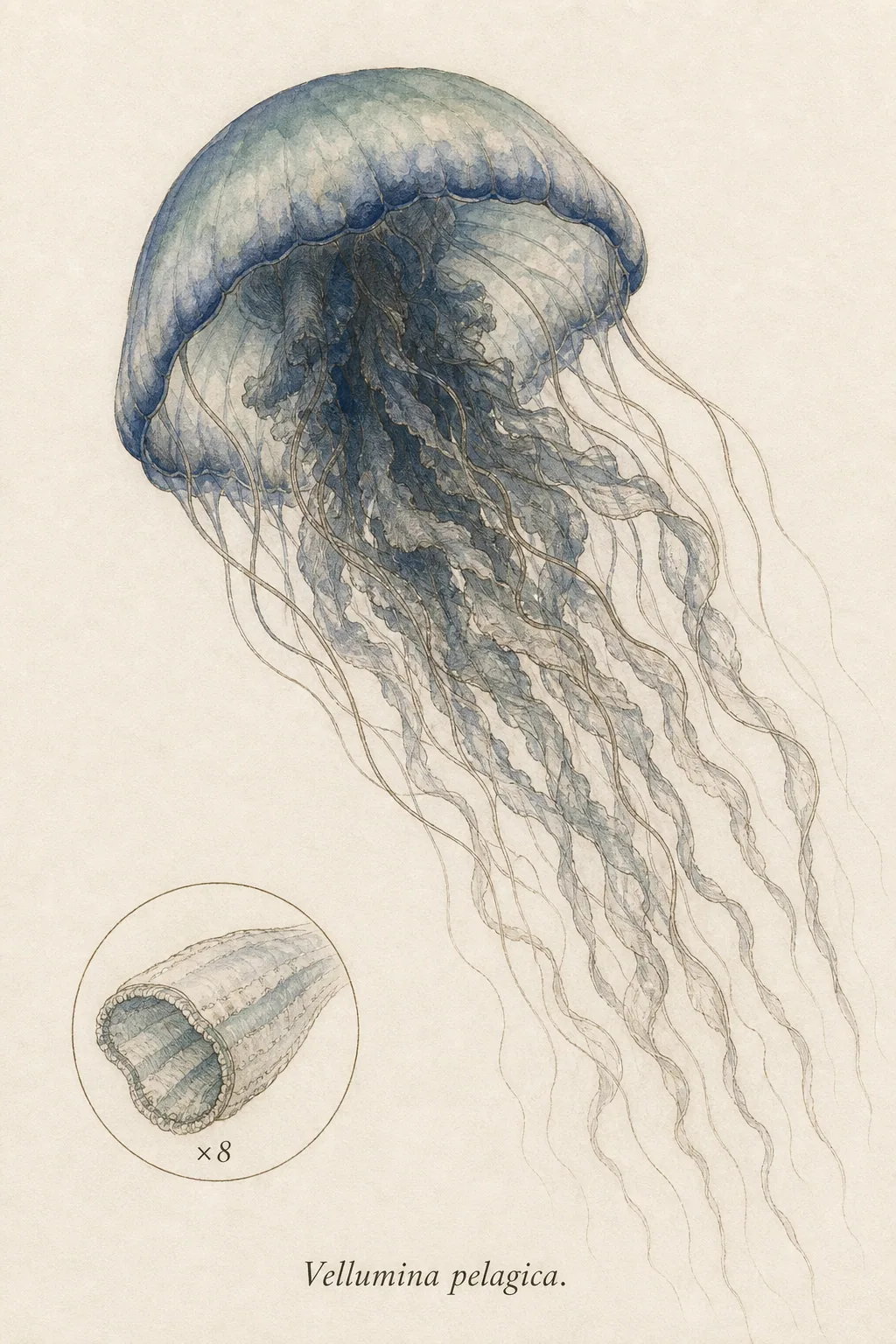
An animal one identifies on the monitor without annotation, which is rare. I have logged Vellumina more times than any other midwater cnidarian and learned almost nothing about it that the first sighting did not already say. I record this here because the not-learning is the relevant fact.
The glass-shawl medusa is one of the few animals a submersible observer can identify on the monitor without annotation. Its bell is wide, perhaps sixty centimetres at the rim, and pale enough to read the pilot's light through. The tentacles extend downward in still water for lengths the survey has estimated, imprecisely, at twelve to twenty metres. They catch almost no light. They are more sensed than seen.
Vellumina pelagica travels in the same vertical bands for long periods. A submersible descending the same water column on successive days has encountered, at the same approximate depth, what appear to be the same individuals — or animals so similar that the distinction is practically immaterial. Whether this is territorial habit, a consequence of neutral buoyancy, or something else is not determined.
Anatomy
The bell tissue is structured in concentric rings that are visible in transmitted light as faint darker arcs. Mouth-arms hang from the subumbrellar surface in a loose wreath. The tentacle arrangement is radial, not clustered; each tentacle is slender and densely coiled when the animal contracts. Nematocysts are present and functional — submersible manipulator contact has provoked discharge response on two recorded occasions.
Behaviour
The animal drifts. This is not an evasion of observation; it is, as far as the survey has been able to determine, the primary mode of existence. Contractions of the bell are slow and intermittent. The medusa does not orient toward or away from the submersible's illumination. Prey capture has been inferred from the condition of the tentacles after certain contacts — matted, not trailing — but has not been directly observed.
Whether the animals encountered on successive days are the same individuals or merely similar enough that the distinction is immaterial — the survey has not determined. I have stopped putting the question to the manipulator arm.