VThe Returning
In this chapter
- 25vBoneward, in winter
- 26vThe Boneward
- 27rLethewards Drift
- 27vThe Reliquary at Pell
- 28rGlass-shawl medusa
- 28vTender north, surface day
- 29vThe Lipless Reach
- 30rThe Surfaceborne
- 30vPlumed gulper
120 m – 180 m · contested
The Boneward
A saturation-depth memorial structure built above a drowned coastal city, maintained by the Bathymetric Conservancy as a site of formal witness rather than commemoration.
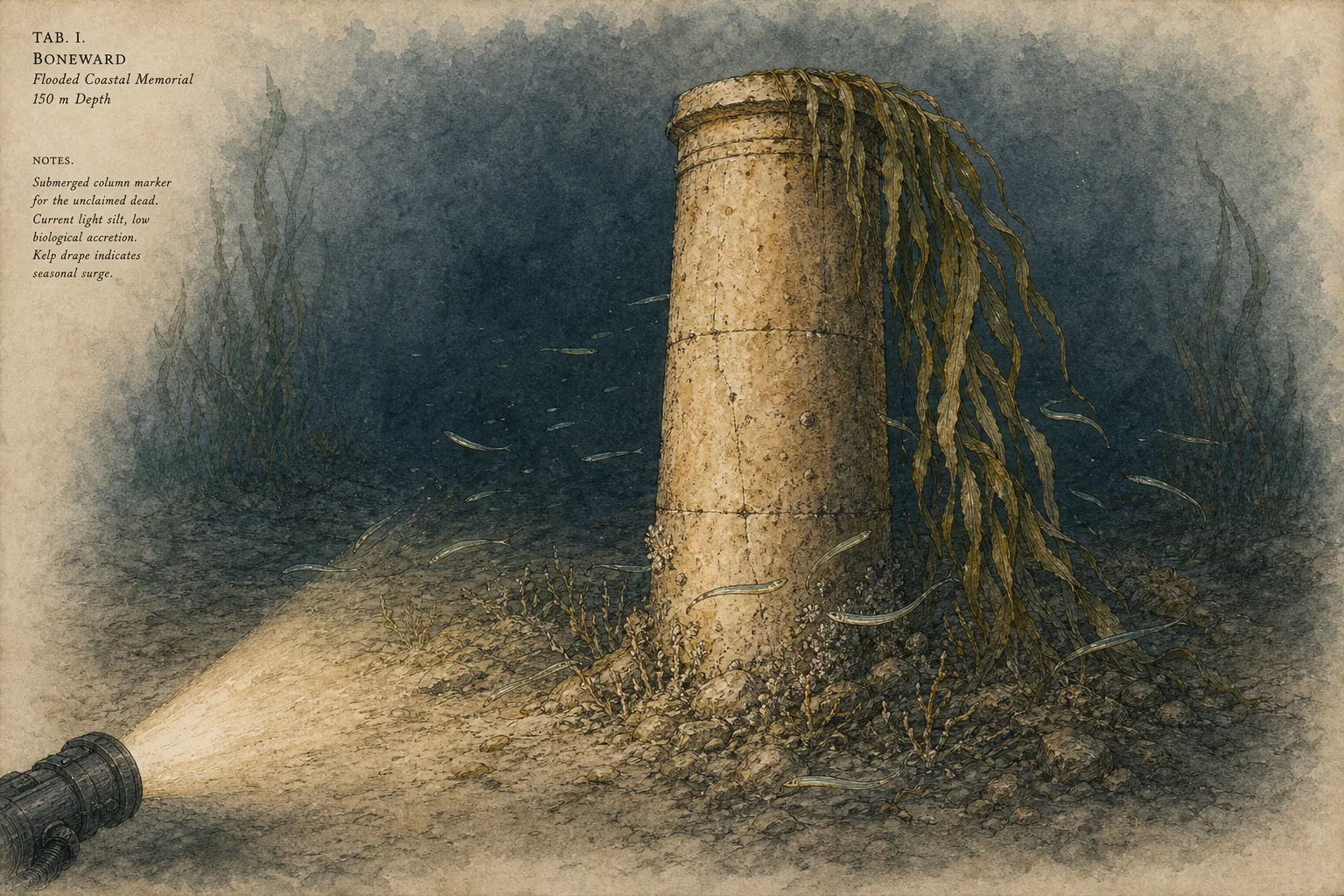
The entry below is the structural account — frames, depths, the Conservancy's installation language. I have kept the affective register out of it on purpose. The Boneward does not mourn, and an entry that mourns on its behalf would be writing the wrong document.
The Boneward sits between one hundred twenty and one hundred eighty metres above what was, in the previous century, a mid-sized coastal city. The water came gradually, then completely. The Boneward is not built from the city's remains; it was constructed afterward, by a joint survey and memorial commission, over the submerged rooflines. It is at saturation depth: access requires heliox and a pressurised habitat, and it is not a site a casual visitor reaches.
What it is
A series of anchored frames — open metal lattices, not enclosures — positioned at intervals above the highest surviving structures of the city below. They do not mark individual buildings. They do not carry names. The Conservancy's installation documentation describes them as orientation markers, which is accurate in the purely navigational sense and says nothing about their intent. Visitors approach them by short sortie from the Conservancy's mobile saturation platform, which anchors at one hundred thirty metres during scheduled access periods.
What it is not
It is not a graveyard. The city's dead are beneath the sediment now, unreachable and unrecovered, and no ceremony of the Boneward concerns them directly. It is not a tourist site — the logistics of saturation access preclude casual visitors, and the Conservancy does not advertise access periods. It is also, and specifically, not a monument of loss in the usual register: no inscription describes what was lost or why. The Boneward does not mourn. It simply marks the location of something that was.
The city below
Acoustic and optical surveys have mapped the submerged streets to approximately forty percent coverage. The survey records are publicly held by the Conservancy but are not displayed at the Boneward itself. Whether a visitor should consult them before or after attending the site is a question the Conservancy declines to answer.
Whether a visitor should consult the survey records before or after attending the site is a question the Conservancy declines to answer. I have stopped asking it of myself.