VThe Returning
In this chapter
- 25vBoneward, in winter
- 26vThe Boneward
- 27rLethewards Drift
- 27vThe Reliquary at Pell
- 28rGlass-shawl medusa
- 28vTender north, surface day
- 29vThe Lipless Reach
- 30rThe Surfaceborne
- 30vPlumed gulper
90 m – 140 m · contested
Lethewards Drift
A ruined habitat cluster on the outer shelf, abandoned during the Subsidence Wars and surveyed but never resettled.
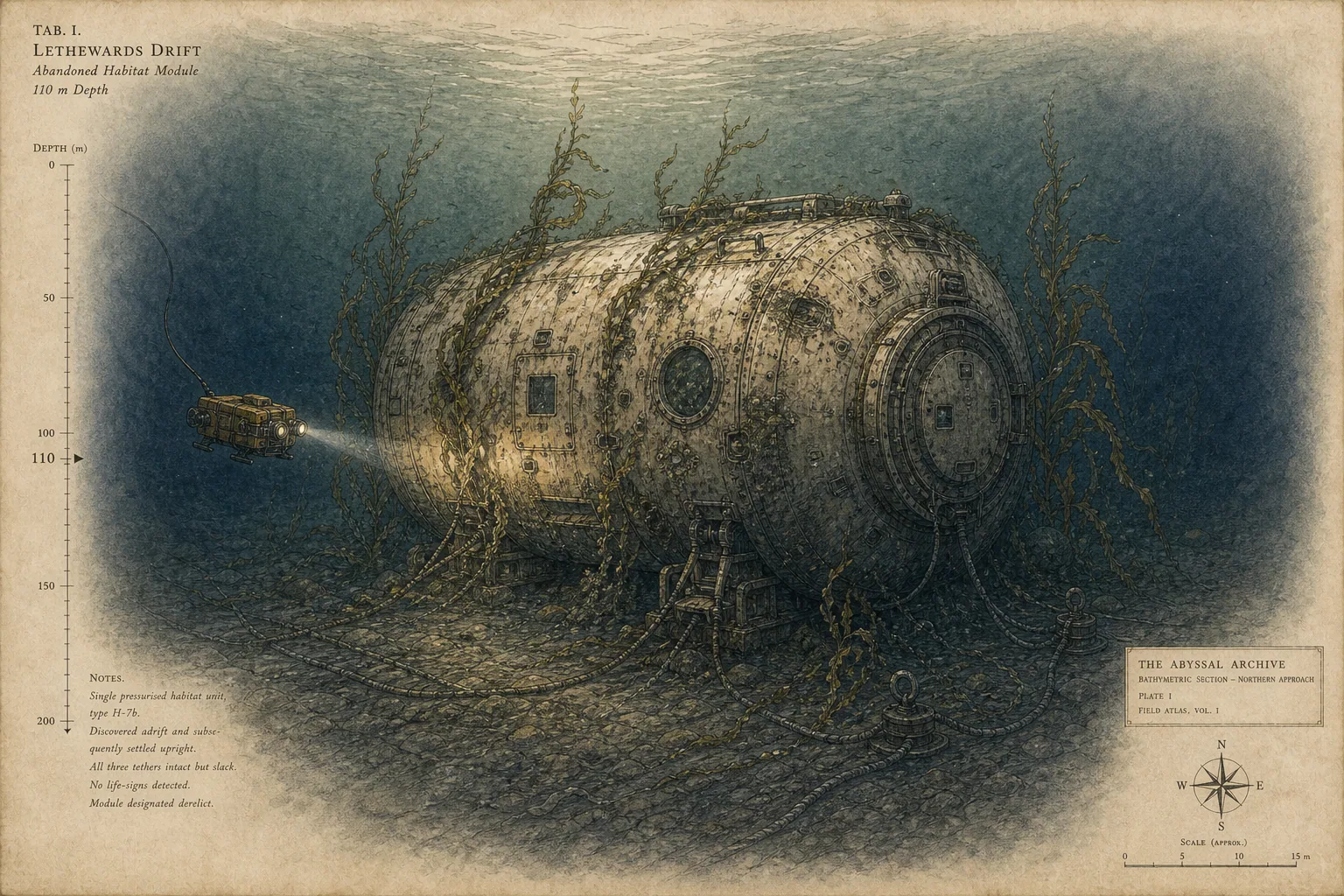
A surveyed ruin that the Conservancy has decided not to repair, for reasons that are not structural. I have written the entry the way the documentation is written — what is intact, what is collapsed, what has not been recorded — and tried not to fill the silence about the people who left.
Lethewards Drift is what remains of a seven-module habitat chain that once served as a staging post along the outer shelf between ninety and one hundred forty metres. The War's final season saw it evacuated in sequence — first the shallowest modules, then the lower rib as structural anchors failed — and it has not been reoccupied since. The Conservancy lists it as a surveyed ruin, category three: structurally compromised, ecologically colonised, resettlement contraindicated.
What the survey found
Three of the seven original modules are intact to working pressure, though none are pressurised. The remaining four show varying degrees of collapse: two crushed by the cable tension following anchor failure; one with a hull breach large enough that a diver can pass through without removing equipment; one simply gone, sheared at the umbilical, its whereabouts unrecorded. Kelp-fanwing nests in the cable runs and around the dead lighting arrays. The Conservancy's last survey logged seventeen individuals in the upper structure alone.
The question of resettlement
It is not a structural question. At ninety to one hundred forty metres, saturation operations are routine, and a repair team could stabilise the intact modules within a working season. The Conservancy's contraindication is jurisdictional: Lethewards sits in contested waters, and rebuilding it would constitute an assertion of claim that no current signatory is willing to make. The habitat decays, and the question is deferred.
What is not recorded
The names of those who left. The Conservancy's documentation covers structural surveys, biological inventories, and depth readings. It does not record who lived here, how long, or in what arrangement. That information exists elsewhere, if it exists at all.
The habitat decays, and the question is deferred. I have come to understand that deferred is, in the Conservancy's vocabulary, a permanent tense.