VThe Returning
In this chapter
- 25vBoneward, in winter
- 26vThe Boneward
- 27rLethewards Drift
- 27vThe Reliquary at Pell
- 28rGlass-shawl medusa
- 28vTender north, surface day
- 29vThe Lipless Reach
- 30rThe Surfaceborne
- 30vPlumed gulper
3,000 m – 5,000 m · fauna
Plumed gulper
An eel-like bathyal predator bearing a dramatic plumed dorsal display, observed in slow deep water near the Vault of Hours by submersible.
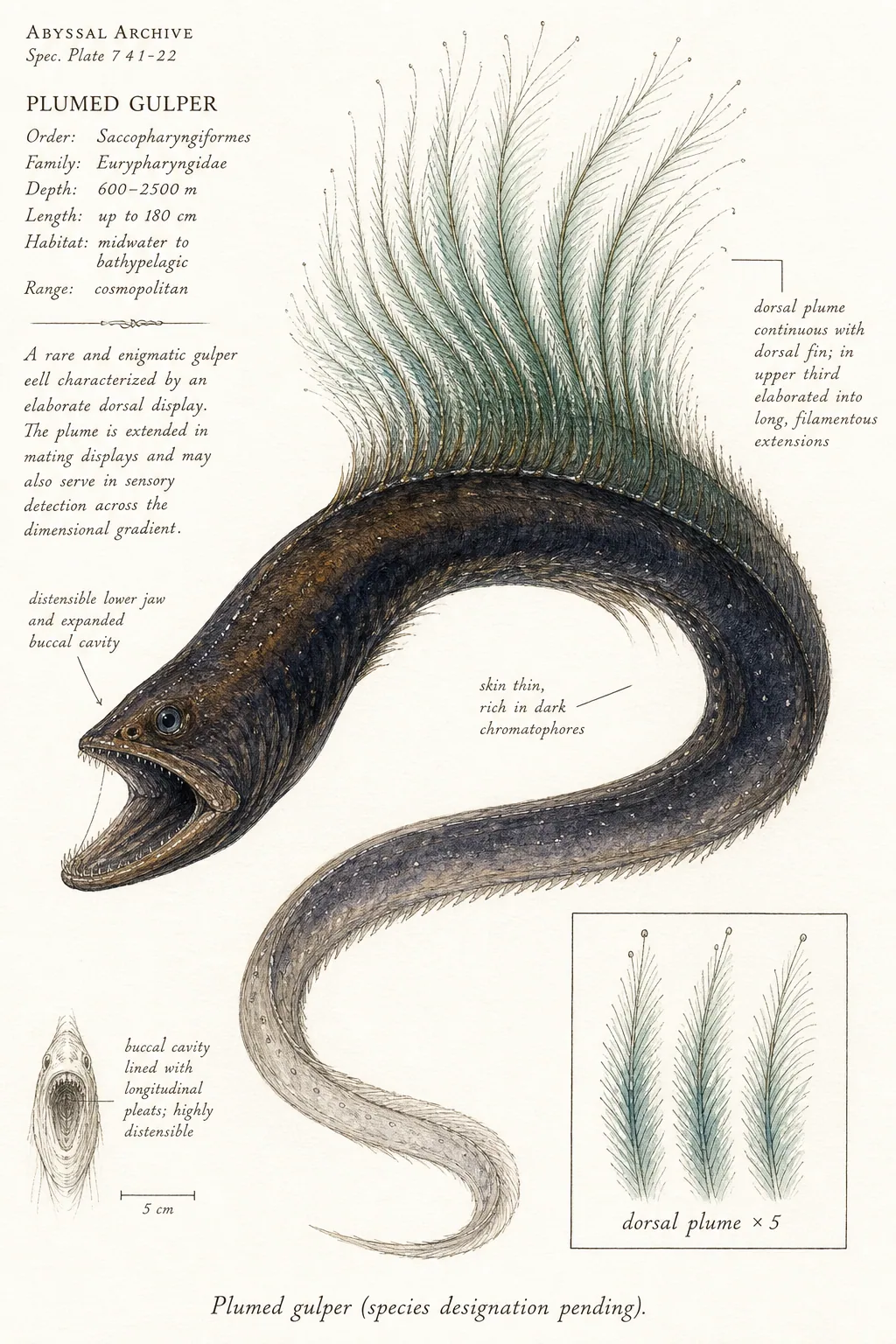
An animal that hangs and waits. The first description came out of a two-day station at the Vault of Hours, where the same pilot logged three individuals; whether these were the same animals returning or different animals using the same column was not established and may not be establishable. I have included it in the closing chapter for a reason I have decided not to write down.
The plumed gulper is large, eel-like, and nearly impossible to observe in motion because it rarely moves. It inhabits the still lower layers of the bathyal column — the water near the Vault of Hours is notably quiescent, held between two opposing current systems — and it uses this stillness. It hangs. It waits. When prey enters the field of its detection, what happens next is fast enough that no submersible camera has caught it in a single frame.
The animal is perhaps one and a half metres in body length, excluding the dorsal plume. The plume is the arresting feature: a series of elongated modified fin-rays extending from the back of the skull to mid-body, each ending in a fleshy lobe that fluoresces faintly in the near-ultraviolet. In darkness, these lobes are visible as a scattered dim array above the body. Whether they function as lure, as camouflage, or as something else is debated.
Anatomy
The jaw is distensible and the stomach expandable, in the manner of deep-sea gulpers generally. The body musculature is dense at the head and tapers sharply toward the tail, which terminates in a narrow finned blade used for directional correction rather than sustained propulsion. The dorsal plume is not retractable. When the animal passes through particulate matter, the lobes trail micro-turbulence that is visible under beam illumination.
At the Vault of Hours
The species was first described from Vault of Hours observations, where three individuals were logged by the same pilot over a two-day survey station. Whether these were the same animals returning to the same patch of water, or different animals using the same column, is not established. The Vault's acoustic properties may be relevant; the plumed gulper appears sensitive to the low-frequency noise profiles of submersible approach and adjusts depth accordingly.
The species adjusts depth to the low-frequency profile of submersible approach. Whatever else this means, it means the gulper has noticed us more reliably than we have noticed it.