VThe Returning
In this chapter
- 25vBoneward, in winter
- 26vThe Boneward
- 27rLethewards Drift
- 27vThe Reliquary at Pell
- 28rGlass-shawl medusa
- 28vTender north, surface day
- 29vThe Lipless Reach
- 30rThe Surfaceborne
- 30vPlumed gulper
2187-03-14 · 145 m
Boneward, in winter
A saturation visit to the Boneward, the memorial formation above a flooded coastal city, in the slow grey of March.
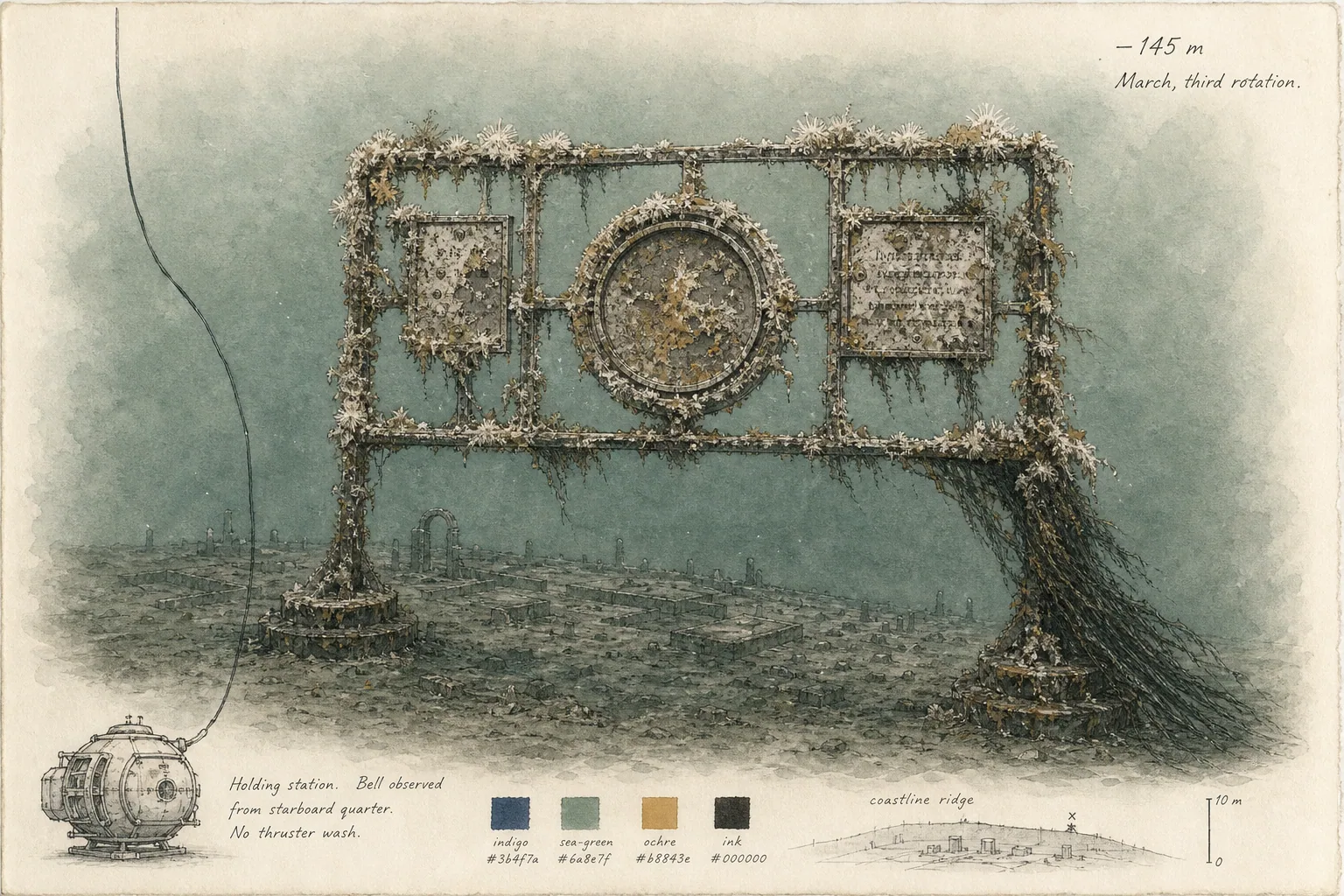
I have written this entry the way I held position on the bell — for the contracted interval, no longer. The Boneward does not argue and I have tried not to argue with it. What follows is the survey from a particular March, in a particular grey, with a colleague whose name I have chosen not to record here.
Nobody talks on the way down. This is not a rule. It has become a practice by the accumulated weight of everyone who has made this descent and made the same choice, and now it is effectively a rule. The pilot does not make small talk. My colleague from the mapping team sits with her hands in her lap. I look out the porthole. The structure emerges from the grey at around a hundred metres.
The Boneward is the memorial installed above the drowned city — I will not use its former name, which is still on some survey charts but which feels, here, like an imposition. The memorial is not large. It was not built to be large. It was built to mark, and marking does not require scale. A frame of treated alloy, seeded with material from the city's last standing structures, draped now in decades of growth that has made it something more organic than intended. The original plaques are visible in places, readable in places, corroded into abstraction in others.
There is a current at this depth that moves along the old coastline — the submerged coast, which is now a ridge — with the consistency of something with a purpose. It bends around the Boneward's frame and continues. I have been told by people who have spent time here that the current is not unusual. Coastal ridge. Normal hydrology. I believe this.
We hold position for the contracted observation period, which is two hours. Long enough to do the survey work. Long enough to sit with the fact of the place without making a ceremony of it.
The grief here is not sharp. I think it cannot be sharp, for me — the city was gone before I was born, and the people who lived there are the grandparents of people who now live elsewhere, who live below. The geography of loss has redistributed. What remains is a quieter thing: the knowledge that something was here, that it was ordinary — a city, a coastline, weather, commerce, people with unremarkable days — and then was not. The Boneward does not argue. It simply persists.
The Boneward does not argue. It simply persists.
I take my measurements. The frame at the southern anchor has some new growth I map and note. A structural assessment would say the alloy is holding. A structural assessment would be correct.
On the way up, my colleague says it is her third visit. She says this in the same tone one uses for a thing that has not gotten easier but has gotten quieter. I nod. The bell rises through the grey.
Above a hundred metres, the light comes back.
M. Vael, ascending from the Boneward, March, third rotation.
I do not know whether I will descend to the Boneward again. The frame at the southern anchor will be measured by someone, on some schedule, and that fact is the relevant one.